Khaled Mohamed Ali El Hishri allegedly committed serious crimes at Libya’s Mitiga Prison from 2015 to 2020, The Hague-based ICC says.
The International Criminal Court (ICC) says it has taken Khaled Mohamed Ali El Hishri, who is wanted for allegedly committing crimes against humanity and war crimes in Libya between 2015 and 2020, into custody.
El Hishri was “surrendered to the custody” of the court in The Hague, the Netherlands, on Monday, by authorities in Germany, where he was arrested on July 16 this year.
Recommended Stories
list of 4 itemsend of list
“Mr El Hishri is alleged to have been one of the most senior Mitiga Prison officials, where thousands of persons were detained for prolonged periods,” the ICC said in a statement.
“He is suspected of having committed directly himself, ordered or overseen crimes against humanity and war crimes, including murder, torture, rape and sexual violence, allegedly committed in Libya from February 2015 to early 2020,” the court said.
The ICC has been investigating alleged crimes against humanity and war crimes committed in Libya since March 2011, following a request from the United Nations Security Council (UNSC).
Situation in #Libya: Khaled Mohamed Ali El Hishri is in #ICC custody, at the ICC Detention Centre in The Hague (Netherlands). A hearing will be scheduled in due course for Mr El Hishri’s initial appearance before the Court. Learn more ⤵️ https://t.co/6kvEZ6Ei1Y
— Int’l Criminal Court (@IntlCrimCourt) December 1, 2025
El Hishri’s transfer to the ICC’s custody comes a week after the court’s deputy prosecutor, Nazhat Shameem Khan, briefed the 15-member UNSC in New York on the details of the ongoing case, saying that “there is a new momentum towards justice in Libya”.
“For too long, crimes committed in detention facilities in … Libya have represented a no-go area for accountability,” she told the UNSC. But she added that the court has been facing “unprecedented headwinds”, including intimidation of its officials.
“It is the victims of murder, sexual violence, torture and the other most serious crimes addressed by our Court that stand to lose the most from these coercive actions,” she said.
Although Libya is not a party to the Rome Statute, the treaty which created the ICC, it has accepted the court’s jurisdiction over its territory from 2011 to the end of 2027, as of May this year.
The ICC still has nine other outstanding arrest warrants in relation to the same case, including for former Libyan leader Muammar Gaddafi’s son, Saif Al-Islam Gaddafi, and Chief of Judicial Police Osama Elmasry Njeem.
Njeem was detained in Italy in January this year, but within a few days, he was reportedly released and transferred back to Libya, where he faced arrest last month, according to media reports.
The ICC released a statement at the time of Njeem’s release from Italian detention, reminding governments that are party to the Rome Statute, which includes Italy, “to cooperate fully with the Court in its investigations and prosecutions of crimes”.
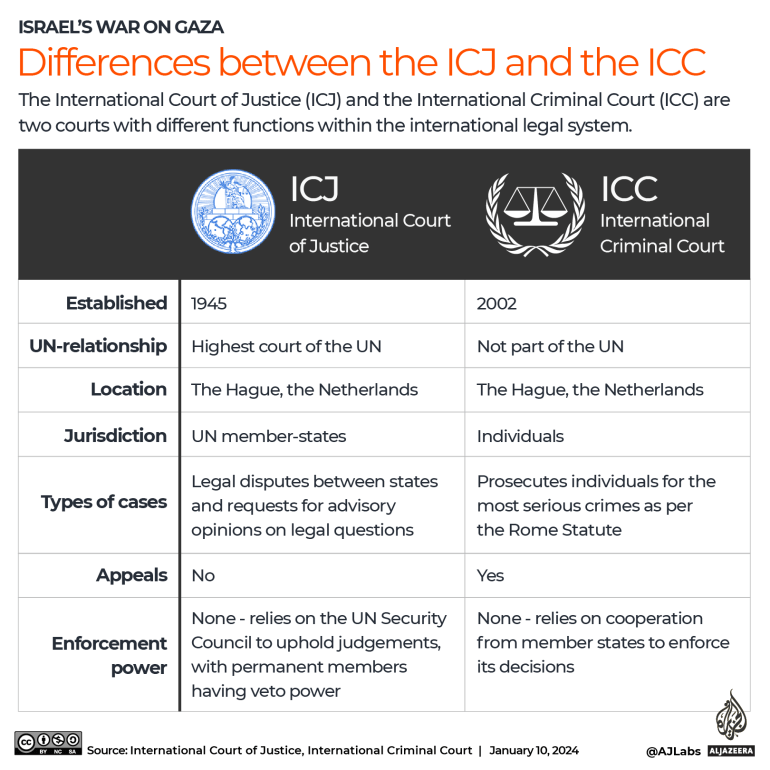
Established in 2002, the ICC is responsible for prosecuting individuals wanted for serious crimes, including war crimes and crimes against humanity.
The court relies on cooperation from its member states to enforce its decisions.
Unlike the International Court of Justice (ICJ), which is also located in the Netherlands, the ICC is not part of the UN.