


In the end, it might take that crosscourt half-smash that’s not been played the whole match, the floaters to midcourt on the backhand, the short angle flick serve, the counter-dribble to force an opponent to hit into the net after being surprised. But to get to those moments from 25 years ago, when Pullela Gopichand finally defeated Peter Gade at the All England semifinals in 2001, can take an almighty physical effort. Technique, tactics, and tenacity won him the coveted title back then. And videos will capture the epic drama that went into finally winning the one big ring to school them all.
But interspersed in his story of triumph, often written over by his tale as a coach, are the nuggets on what went into culminating in that one title as a player. 150 kg squats, recalls his former SAI coach Ganguly Prasad, though he adds a caveat up front: weight training alone can’t make you a champion if the technique is all over the place.

But for each descriptive passage on Gopichand’s badminton intricacies in the book penned by Sanjay Sharma and Shachi Sharma, there are words on fitness that jump out from the pages, underlining its importance: there might not have been an All England in Gopichand’s name a quarter century ago, had he not built up strength – and speed, and a mesh of them both in intensity.
The broader contours are well known: physical fitness improves mental strength and decision making on Saturday semis and Sunday finals of big events, and endurance to nail titles till the last point of the final. A fresh-staying brain even when the limbs are threatening to give up, can conjure plans, think on its feet. For all this, hours and days, and in his case years, can go into preparation for that one moment. Like, when Peter Gade came from 4-11 to level at 14-14 after Gopichand fluffed four match points, and forced a clutch situation. It’s fairly well known that the semis – he had never taken a game off the Dane – tested the Indian more than the finals at Birmingham.
But after three knee surgeries, a heartbreaking Olympics because the flooring at Sydney in 2000 was concrete and the shocks of the jump smashes literally made him feverish, leading to a loss, and after putting six years into strengthening his badly blasted left knee, there arrived moments in that All England, when years of monkishly focusing on fitness yielded a return. There was a time when, Sharma’s book says, Gopichand strapped on Tata Salt bags, and later 2 kg sandbags and travelled in trains, buses, and flights working on his knee extension to strengthen the joint. When he started this, he was still coveting his first elusive National title in 1995, but the effort to keep getting stronger went all the way till the All England six years later, with constant thoughts that destiny was doing him in.
The book – a relevant read even 25 years on – is instructive because India once again finds itself at a crossroads where the new young shuttlers coming onto the international circuit, seem well-versed in the nuances of shot-making and racquet-skills, but can quickly fall out of the reckoning, if their fitness standards are not raised – considerably.
Story continues below this ad
The first thing the 2026 All England champ Wang Zhiyi’s coach told the Chinese player when she finally defeated An Se-young after 10 losses and 8 runner-up finishes in finals, was that it was her punishing morning sessions in fitness that had given her the win, when she indicated “no more morning sessions” right after winning. Its relevance might be up for debate, but the All England tournament extracts exacting fitness standards, and for Gopichand that included playing the German league for years, where the shuttles were so slow, hitting tosses from baseline to baseline needed an almighty effort, as per the book.
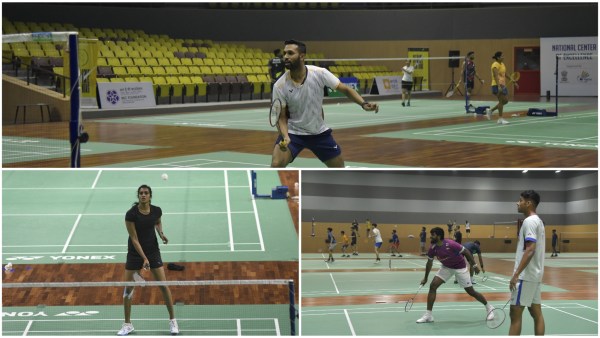 HS Prannoy, PV Sindhu and Satwik-Chirag in action at a team camp in Guwahati ahead of BAMTC. Credit: Badminton Association of India
In the book ‘The World beneath his feet’, Gopichand narrates the times when his Chinese coach drilled into him the importance, “I was fit before but not strong, and this meant I lost by the time I reached the third or the fourth round of any international event. The Chinese coach (at Langenfeld, Germany club) made me realise the full and fantastic benefits of muscle-strengthening, and we got into lifting some really heavy weights in the months I used to visit Germany….it inculcated in me the belief that I could really match the stronger Europeans and the faster Chinese/Indonesians. I realised that correct weight training was the way to rising higher in world rankings.”
Elsewhere he is emphatic when he says, “The only reason why Indians could not fight at the top world level was because physically our players were just not at par.” It resonates with the fitness levels of upcoming names even today.
It’s not a new battle – it’s one he’s fought before when he started as a coach in 2006, and put Saina Nehwal, PV Sindhu, Kidambi Srikanth, Sai Praneeth, and HS Prannoy through the rigours, taking them to Olympics or World Championships medals. Most of the new wave of players coming through, from different corners of India, were not even born in 2001, but might need to be bombarded with this basic advice that until they get stronger, they won’t last in the match to unfurl their beautiful, talented games. They see Lakshya, Satwik-Chirag, Saina and Sindhu and Prannoy play those unbelievable shots, but not the bedrock of fitness work on which those matches stand.
Story continues below this ad
ALSO READ | Carolina Marin steps back to heal, a brave move in a relentless career
For Gopichand it tended to be at times, 150 jump smashes, dribble and flick control drills, from all angles, defense workouts vs 3 for four hours, followed by weights, sprints, rope skipping, amounting to 7 hrs a day. It’s not a regimen to be blindly followed or rushed into, but it needed that for stars to align towards his All England. Moreover, the confidence that he could beat any player on a given day, sprung from his fitness base.
His 10 minutes on, 1 minute off drills that went on for hours, where he took on multi shuttles, might be well known now. But like Malaysian Misbun Sidek pointed out recently, upcoming Indians aren’t exactly up to scratch in fitness, for the intensity needed to win titles. When they won their World Championships medals, Srikanth, Prannoy and Sai Praneeth will each attest to being physically at their sharpest.
Gopichand says in the book, “I felt great about the wins but it all depended on how fit I was. I knew if I was injury-free and match-fit I could face these (big name) guys in every way..I had to get back and play the same type of game against all such players – quicker, play fast, be aggressive all the time. So fitness was the key. And being injury-free.”
Story continues below this ad
Fitness can be crunched into better punch in the smash, control at the net, keeping energy for the end of the long rally. “If I reacted quickly and was still aggressive, it was going to be effective…” he would add.
It’s not a massive surprise that Lakshya Sen who puts in that amount of work into fitness (a thin line that of overtraining), while balancing it with injury maintenance, made the most recent Super 1000 final.
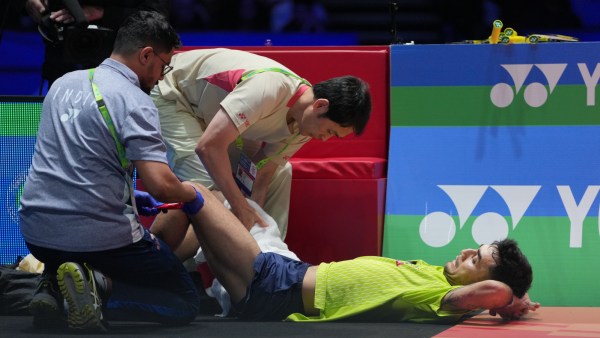 India’s Lakshya Sen receives medical treatment during his men’s singles match against Canada’s Victor Lai during All England semifinal match. (PHOTO: AP)
Victor Lai is no Peter Gade – yet. But there was a similarity in the semifinals of 2026 and 2001. Long rallies. What used to often hurt Gopichand was that Peter Gade would stare at him across the net “as if I couldn’t take another long rally.” It was one of the many scores settled at All England 2001. “Plan was that the longer the rallies went, I finished with a smash, looked him in the eye, glared at him, and got ready for the next rally before him. I was instantly ready to serve while he took his time. This was just to prove that this time I was not down on fitness and speed,” the book quotes.
On three painkillers on semis day, the Indian could pull off, “Low serve, fast counters, and smashes all the way.” And then his superior fitness beat Chinese Chen Hong in the finals too.
Story continues below this ad
Fitness doesn’t ooze like his net flicks or half smashes and killer construction of points anticipating the anticipation of opponents with the heart pumping at a ridiculous rate. It’s invisible, non-quantifiable, and a perform-or-perish data point in Chinese badminton. Strokes can be recorded and emulated frame by frame. In badminton though, you need the brutal to supplement the beauty, and Indian badminton with its fractured, incoherent spread-out system with different coaches, not always in sync with physical trainers, is faltering right now.
He discovered ice therapy and recovery rather late, but Gopichand won’t tire of repeating that his base of fitness and strengthening helped him play those right strokes at the right time. Fundamentals apply, as time goes by.


