


What once looked like stability now looks like structure under strain — and responsibility is harder to separate from influence.
The IPL has never really traded in the kind of public needling that defines football management. Opposition coaches do not usually take sly digs at their peers the way Premier League managers do. Which is why Hemang Badani’s assessment of Stephen Fleming landed so sharply — and why, with Chennai Super Kings in visible decline, it now feels less like provocation than a challenge.
Badani’s claim was blunt: CSK were not really being run by Fleming at all, but by MS Dhoni. Fleming, he suggested, was celebrated for a success he had not replicated elsewhere, while Dhoni remained Chennai’s true cricketing brain, its “kingpin” and “maharaja”.
At the time, it was easy to dismiss that as incendiary. Now it sits more uncomfortably. Because the question around Chennai is no longer simply why they are losing. It is who this failure belongs to.
For years, CSK existed in a structure where everything — tactically, emotionally, symbolically — began and ended with Dhoni. That was both strength and ambiguity. If Chennai were calm and precise, Dhoni absorbed the credit. If they looked stale, blame drifted elsewhere.
Even those inside the CSK ecosystem have acknowledged this balance. In an ESPNcricinfo conversation, Ambati Rayudu said plainly: “It is MS Dhoni who calls the shots,” later describing CSK as “MS Dhoni’s team.” That matters now, because the buffer is thinner than before.
Around the franchise, Fleming has become more central to decision-making — selection, direction, identity. Even when Dhoni returned as stand-in captain after Ruturaj Gaikwad’s injury, this season has felt less like his last stand and more like Fleming’s test. That is what makes the slide so damaging.
Story continues below this ad
ALSO READ | Chepauk has stopped asking ‘when will dhoni bat’ and started asking ‘why’
Not just because CSK are losing, but because the losses read as an indictment of the ideas behind them. Missing the playoffs once can be explained away. Missing them again raises larger doubts. Finishing bottom while looking tactically dated makes it more serious: a rupture in identity.
CSK no longer look like a team in transition, but one struggling to recognise the competition they are in.
With Dhoni around, perception was always his hardest battle. The captain’s shadow was too vast; every good decision could be attributed to him, every bad one displaced. But this feels, more than before, like Fleming’s CSK — and therefore Fleming’s reckoning.
Story continues below this ad
The criticism has grown because it strikes deeper than results. It questions whether Fleming has kept pace with the modern IPL. That charge is uncomfortable, but not baseless.
And yet context matters. Fleming is not a conservative relic. Since 2009, he has been one of the IPL’s defining thinkers, building a sustained method with Dhoni: squeeze the middle overs with spin, exploit match-ups, turn Chepauk into a fortress, trust experience under pressure. This was not luck stretched over years. It was an operating system.
Those who played under him describe a coach who did not need theatre to exert control. As Rayudu put it, “it’s a captain’s team” — an understanding that allowed the partnership to function without friction. His authority was expressed through clarity and restraint.
But the modern IPL has shifted in a way that tests that model. Since the Impact Player rule, the league has accelerated into something harsher: bigger scores, deeper batting, and caution punished more brutally. Fleming himself has acknowledged as much: “Everyone is going at a rate of knots… I don’t think there is a thing called finishers anymore.” This is a coach watching the ground move.
Story continues below this ad
The issue is not misunderstanding T20. It is trusting an older grammar for too long while the league learned a new language. CSK have not simply failed to keep pace — at times, they have misread it.
ALSO READ | Stephen Fleming calls for patience, insists underwhelming Indian rookies would be of ‘high value’ in future
While others embraced depth and aggression, Chennai kept trying to restore order: not to stretch the game but to manage it, not to raise the ceiling but to lower the temperature. In an older IPL, that was intelligence. In this one, it has looked like denial.
Fleming’s recent remarks reflect that tension. He has spoken about the league’s pace, the distorted market, the challenge of staying relevant. All true. But it can sound like a coach explaining the game rather than shaping it.
Story continues below this ad
And the IPL is not kind to those who arrive half a beat late.
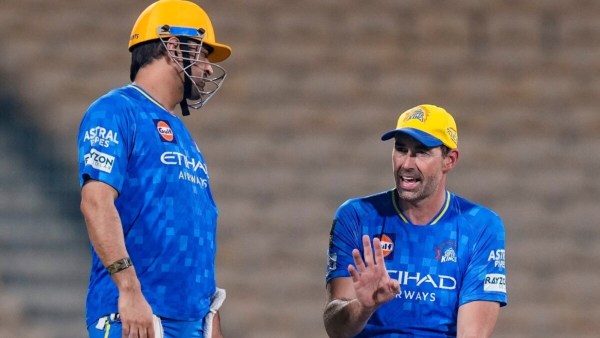 Even when Dhoni returned as stand-in captain after Ruturaj Gaikwad’s injury, this season has felt less like his last stand and more like Fleming’s test. (PTI Photo)
What has preserved Fleming is trust — a luxury few coaches enjoy. CSK’s ownership does not panic; it solves. That patience helped build the franchise. But in sport, patience is not immunity.
There are signs of a pivot — younger players, more attacking options, a search for energy. It would be premature to write him off. Coaches of his calibre adapt. But the questions remain until CSK stop looking like a team caught between identities: too loyal to an old method to leave it behind, too aware of the new game to ignore it.
That is why the scrutiny around Chennai feels different now. It is no longer the familiar noise that follows defeats, but doubt about ideas, authority, and relevance.
Story continues below this ad
The IPL has never granted much patience to delayed adaptation, and for years Fleming was insulated by two stabilisers: trophies in the bank and Dhoni in the room. The first still carries weight. The second no longer protects in quite the same way.
So the question at Chennai is no longer whether Stephen Fleming deserves respect. He has earned that beyond argument. It is whether, despite Dhoni’s lingering shadow over how this franchise is understood, responsibility for what CSK become next now rests with him — and whether a coach who once helped define the rhythm of the IPL can still keep time with it in a league that has moved on from waiting.


