


Sachin Tendulkar had been watching carefully. Bhuvneshwar Kumar’s seam, he noticed, was no longer pointing anywhere in particular. Not towards slip for the outswinger, not towards leg slip for the inswinger. When the ball landed, it could go either way. The batsman’s only information arrived after the ball had already moved.
“He’s right,” Bhuvneshwar says, when asked about Sachin. “And who can observe better than him?”
This is June 2026. Sachin has just been analysing Bhuvneshwar’s wobble seam on social media. Vaibhav Sooryavanshi, 15 years old, has just broken Sachin’s 36-year record as the youngest player selected for the Indian senior team, after finishing IPL 2026 as its highest run-scorer. The boy Bhuvneshwar bowled with a knuckleball in 2025 is now the most discussed cricketer in the world. And here is Bhuvneshwar, 36, the only man to win consecutive IPL Purple Caps.
***
The truth, as best as Bhuvneshwar can reconstruct it, begins somewhere around the age of 14 or 15, with a bowling action that went wrong.
He had come to the game late, by serious cricket’s standards. When he first bowled in the nets, the coaches told him the ball was swinging. It seemed normal to him. The other kids swung it too. He didn’t know there was anything unusual about his hands until the coaches kept saying it, and even then it was only when he played under-17 cricket that he started to understand what they meant.
“I was mainly an inswinger when I started playing cricket,” he says. “Some part of the action changed — think I must have been around 15-16 perhaps. And I started outswinging. Slowly, I understood how to outswing, inswing. This is my luck. I won’t say I was born with it, or someone taught me. It was my luck that some action went wrong, but luckily I understood how to swing on both sides.”
Some actions went wrong. Most cricketers spend careers trying to prevent that. Bhuvneshwar’s career was built on it. The outswinger, the delivery that would eventually put him on the Lord’s honours board and make Tendulkar watch a video and think about seam angles, came from something he didn’t intend and couldn’t quite explain.
Story continues below this ad
“No one taught me how to swing on both sides,” he says. The coaches who shaped him are Vipin Vats, who also taught Praveen Kumar, and Sanjay Rastogi. Both from Meerut. He says he was lucky to have them.
At home in those years, the 10-year-old would return from training so exhausted that eating was beyond him. His mother assigned his elder sister the daily duty of feeding him as he lay sprawled on the bed. His sister would feed him while he drooled on the pillow, already asleep. In Meerut, they call a man like this a karmath cricketer. A man who believes in the work, not the mythology around it.
***
In January 2009, Bhuvneshwar Kumar was 18 years old and playing for Uttar Pradesh against Mumbai in the Ranji Trophy. The night before he was due to bowl at Tendulkar, he dreamed about taking his wicket. Ashish Zaidi, the UP manager, found him and offered some counsel. Tendulkar isn’t going to take your life. Worst case, six sixes. Don’t do anything special. Fix a spot and bowl there.
On his 14th delivery to Tendulkar, Bhuvneshwar bowled full. The seam rushed across through the air, straight, before cutting in sharply to kiss the edge, onto the pad, popping up to a tumbling short midwicket. Tendulkar’s first duck in Indian domestic cricket. Bhuvneshwar’s phone was busy for two hours after the game.
Story continues below this ad
Seventeen years later, the philosophy is unchanged. Fix a spot. Bowl there. Don’t try anything special. The language has evolved: gut feeling, mental notes, wobble seam, body control. But the essence of his art hasn’t changed.
***
“No, sir, till date, I haven’t received any advice that has changed my life. There is not a single advice that has drastically changed my bowling, that has changed my life. Bowling is not that simple, you have to work hard for it.”
What he controls is the preparation: a trainer, a physio, a dietitian, a schedule that runs through the off-season whether a tournament is approaching or not. “The schedule is very simple. Almost, if I’m not on a holiday, the gym training goes on.”
The mental notes he keeps are not written anywhere. They are things he has seen and become convinced of. He watched Praveen Kumar bowl for years. Not looking for one thing. Just watching. PK’s bowling changed at some point because somebody told him to get as close to the stumps as possible, especially for his inswinger. Bhuvneshwar absorbed it. “I think it’s a gut feeling,” he says. “And gut feeling comes with experience.”
***
The bouncer arrived the same way.
Story continues below this ad
At low pace, a bouncer is an invitation. Bowl it at 130 kilometres an hour and the batsman has time to pick the length, get into position, and clear the boundary with something to spare. This is cricket’s received wisdom on medium-pace bowlers. Bhuvneshwar understood it and initially accepted it.
“Initially, there was no confidence,” he says. “Because it’s low pace, you bowl a bouncer, it’s a six.”
But he kept trying it in practice, putting in extra effort on the delivery to see what happened. “Once or twice, it was fast. Then slowly I understood how to control the body. Slowly I started understanding that yes, if I put more effort than normal effort in a bouncer, it will come out extra. So I started trying it consciously in practice, then it became a habit.” He found out the bouncer was working not from his own assessment but from his seniors in Ranji Trophy. “Someone said, your bouncer is fast. I thought, I don’t know why he is saying that. Even I don’t know. But slowly the seniors say that the bouncer is fast, then someone says, maybe that’s why. Then slowly you understand things.”
He reverse-engineered his own weapon from other people’s surprise at it. In his international past, he had taken out Babar Azam with it. When a full outswinger was driven to the long-off boundary, he served a short nasty one next delivery and a startled Babar dollied a catch to short fine-leg.
Story continues below this ad
In the IPL 2026 final against Gujarat Titans, Bhuvneshwar needed wickets. He had been watching Josh Hazlewood bowl a bouncer to Sai Sudharsan a few overs earlier. Sudharsan went to pull and the ball just dropped awkwardly. Bhuvneshwar kept it. “I was watching and suddenly I was reminded that yes, this can also work. So that, it was about watching things.” He bowled the bouncer. Sudharsan was gone. From something he had seen and held.
***
December 30, 2012. Chennai. ODI debut against Pakistan. India finished with 227/6 and needed early wickets to defend it. Dhoni threw Bhuvneshwar the ball for the first over. His first delivery in ODI cricket was an inswinger to Mohammad Hafeez. Hafeez left it, reading it as going straight through to the keeper. It crashed into the stumps instead.
“I don’t think I have got the ball to swing as much as that debut wicket,” Bhuvneshwar says, years later. “I don’t even know how I did that much swing bowling.”
The greatest ball he bowled as a young man is one he cannot account for.
Story continues below this ad
July 2014. Lord’s. His first Test at the home of cricket. Six wickets: Alastair Cook, Sam Robson, Gary Ballance, Ian Bell dismantled in sequence, then Ben Stokes. The Stokes ball pitched off-and-middle, sneaked back through the gate between bat and pad, and took out the stumps. His name went on the honours board, only the third Indian to take six at Lord’s, after Amar Singh in 1936 and Bishan Bedi in 1974. A family friend in the UK sent him a photo of the board with his name on it. He mentions this the way a man mentions a thing he is glad exists, not a thing he needs reminding of.
***
January 2018. Wanderers, Johannesburg. The third Test. India, two down in the series, needing something.
AB de Villiers came to the crease at 88 for 3, South Africa needing their best batsman to change the course of the match. In what happened next, the scorebook records 19 balls, 5 runs and a broken stump.
Bhuvneshwar had been bowling de Villiers a sequence of outswingers. Nothing to drive, nothing to flick, just balls that started at sixth stump and moved further away. De Villiers played them with soft hands. Edges didn’t carry. He shouldered arms. Five runs in 14 balls, the most destructive batsman of his era reduced to something between patience and frustration by Ishant Sharma and Bhuvneshwar.
Story continues below this ad
“I had in mind that the more I delay putting in the inswing — sometimes if you give the batsman a few outswings, unknowingly, even after knowing it, he starts moving towards the ball. Technically. He starts moving towards the ball.”
At 36.4 overs, Bhuvneshwar bowled full. It started at sixth stump. Late inswing. De Villiers was already moving towards where the outswinger should have been. The ball went the other way, brushed the back leg, took out the middle stump.
“I knew which line to put it in”. Commentators had one word for it. Wow.
***
The match Bhuvneshwar remembers most is not Johannesburg. It is Eden Gardens, 2017, against Sri Lanka.
Story continues below this ad
“Not a particular ball,” he says, when asked. “But as a bowler if I say a Test match which I like a lot, that was against Sri Lanka in India. Eden Gardens in 2017. Where I got 4-4 wickets in the first and second innings. 4-4, 8 wickets. I enjoyed that a lot. Even now when I remember it, I feel good. It’s not because of any particular wicket.
It’s just the full match. The way I got the wickets there, on swing.”
The second innings tells you why. India needed to bowl Sri Lanka out inside a session, the surface dry, the target 231. Bhuvneshwar struck in the very first over: Sadeera Samarawickrama chopped a delivery onto his stumps for nought. Four wickets for 8 runs across 11 overs, 8 of them maidens. By the end, the ball was reversing, which he hadn’t planned on but recognised and used. “The ball was reversing, so that helped,” he says. Bad light saved Sri Lanka at 75 for 7. He was named Player of the Match.
He cannot name you a single wicket. Johannesburg he remembers ball by ball. Eden Gardens he remembers as a feeling. The difference is not about importance. It is about what the memory holds and what it lets go.
***
The wobble seam that Tendulkar noticed in 2026 is not new. Bhuvneshwar has been trying it since before Covid. But not consistently. Not convinced enough. The conviction came slowly, the way everything has come slowly for him: through experience accumulating until it becomes certainty.
The old instruction was the opposite. Put it on the seam, something will happen. That wisdom was true when the ball was good enough to respond. “The quality of the ball was so good, that if you put it in the air, it will swing,” he says. “But as the quality of the ball has reduced, things evolve.” The wobble seam is what that evolution looks like: a delivery designed for a world where the ball no longer does what it once did.
“It was not that I was not convinced, but it was that swing, inswing, outswing, which is natural, so odd ball, let’s say in one day, 4-5 balls, in T20, 1-2 balls. But that experience, which wicket works more, which batsman can work more, for the last 2-3 years, I have been doing this a lot.”
The mechanics are as simple as he can make them. The ball should not land on the seam. That is the whole thing. “The main objective is the ball should not be landing on the seam. That’s a simple thing.” When it doesn’t land on the seam, it can go anywhere. He doesn’t try to give it direction. “No, just normally, normally. You don’t even want to do that. Because you also don’t know where the ball is going to go, that’s the thing.”
The batsman reads the signal and plays. Bhuvneshwar has spent 15 years removing the signal. The outswinger told you something and then arrived somewhere else. The wobble seam tells you nothing at all and lands wherever it decides.
This season he took Test-match thinking into T20. “In T20, technical things matter a lot to the batsman. To hit a six, you have to be technically sound. If you are not technically sound, then very basic things like the shoulder opening, I tried to exploit that this year.”
Tendulkar watched all of this from outside and named it. Bhuvneshwar agreed and moved on.
***
He doesn’t lobby for a national recall. When people say he should be playing for India again — and after two consecutive IPL Purple Caps, more and more people are saying it — he acknowledges the question and declines the theatre of it.
“It’s my nature that I don’t want to show that I want to play,” he says. “I think everyone is doing their job. Selectors are doing their job. I’m doing my job. It’s their responsibility to select. If they think I’m good enough, they will do their job.”
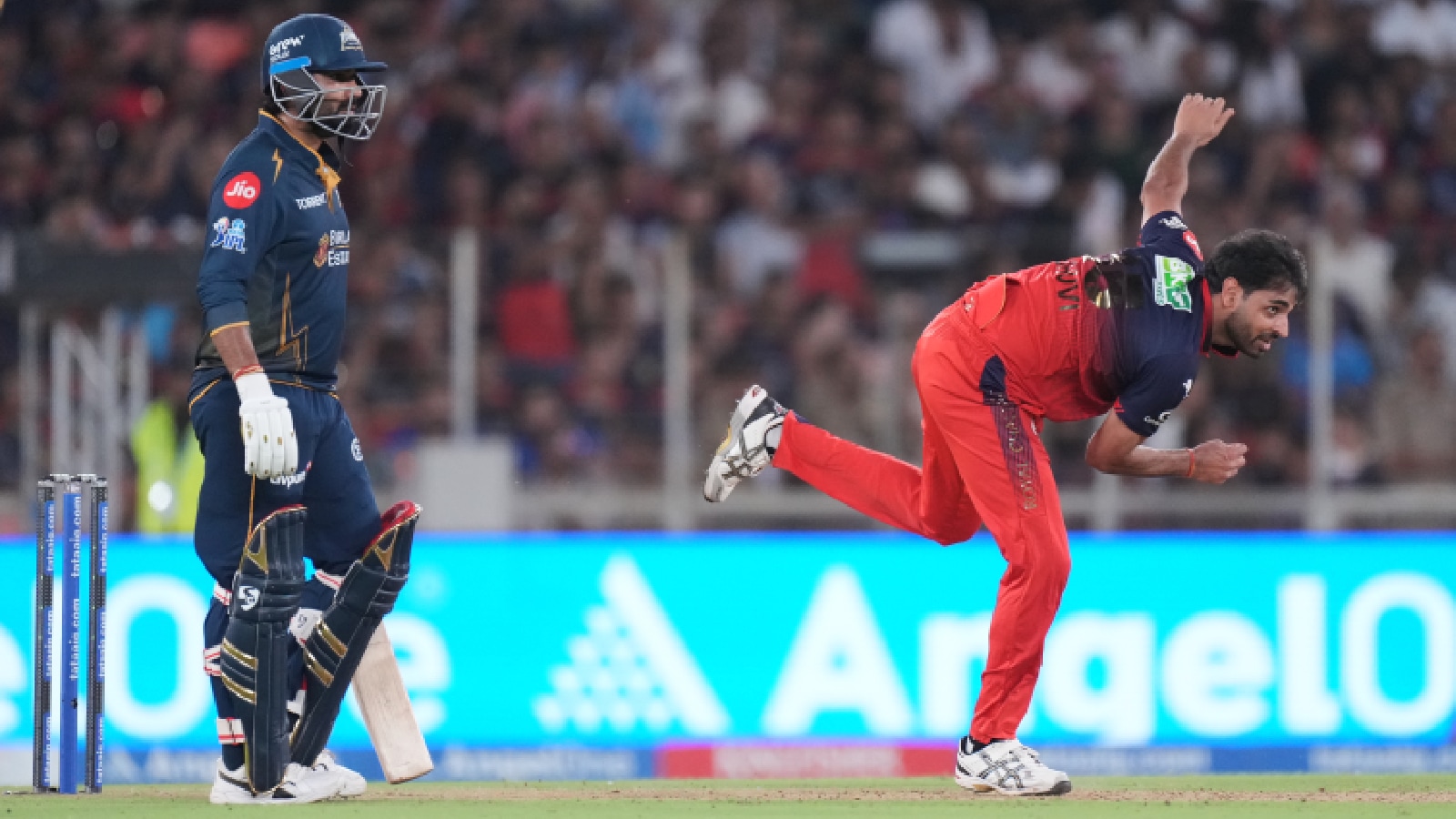 Royal Challengers Bengaluru’s Bhuvneshwar Kumar bowls a delivery during the Indian Premier League final cricket match between Gujarat Titans and Royal Challengers Bengaluru in Ahmedabad, India, Sunday, May 31, 2026. (AP Photo)
When pushed, he admits that he wants to play. He just won’t perform wanting it. “I have played, I have done what I had to do. If I hadn’t played, I would have been dying to be asked to play a match. I think it’s a big thing to play for India, I won’t say it’s a small thing, I’m one of the lucky ones that I have played.”
He turns warm and flows freer on the subject of Sooryavanshi. “He gets into nice shape and position. Sometimes even if he is not in position, his bat speed is so fast, he manages with that. So I think this guy is special. I don’t know what’s written for him, but if everything goes well, he will break and make many records.”
In Meerut, they have a word for what Bhuvneshwar is. Karmath. A man who does the work and trusts the karma. The wobble seam came from a boy whose action went wrong at 14, who learned his bouncer was fast from someone else’s surprise, who spent two decades filing mental notes he never wrote down, and who once beat AB de Villiers with a ball he’d been planning for six overs and still wasn’t sure would swing. He isn’t downplaying any of it. He just knows the difference between what he did and what he can explain.
“It’s simple,” he says. “It’s not rocket science.”


