


On the back of France’s 2-0 defeat to Spain in the World Cup semi-finals, the French media were ruthless in characterising the performance as powerless in attack and lacking a plan B, in contrast to the surgical efficiency of Spain’s style of play.
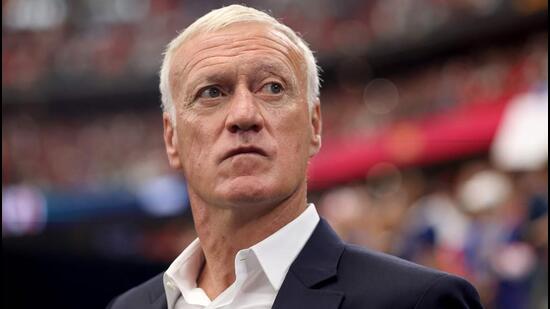
At the centre of much of this criticism were left-back Lucas Digne for giving away the penalty, captain Kylian Mbappe for registering more offsides than shots on target, and head coach Didier Deschamps for being tactically schooled by Luis de la Fuente for the third consecutive summer.
Once teammates of Deschamps in France’s victorious 1998 World Cup and Euro 2000 sides, Thierry Henry and Emmanuel Petit also commented.
“If you’re not at the races right from the start, it’s going to be difficult. [Spain] are the worst team in the world to go 1-0 down against,” said Henry during a Fox Sports broadcast.
Petit, in an interview with Talksport, rated the French attack a measly 2/10: “We were so far away from each other. Tactically we lost the game but technically as well, we were so poor. We looked so nervous.”
Publications like Le Parisien are already dusting off this disappointment and looking to the future as Zinedine Zidane is widely tipped to take over as head coach. The publication claimed that Zidane—he has not been officially announced yet—will be expected to lead France to win Euro 2028.
Such is the relentless pressure that comes with the job of coaching Les Bleus these days. It’s a far cry from the state of the team before Deschamps took over—group stage exits at Euro 2008 and World Cup 2010 amid dressing room mutiny against Raymond Domenech had turned Les Bleus into a national laughing stock.
While Laurent Blanc brought progress with a quarter-finals finish at Euro 2012, Les Bleus needed a head coach who could provide long-term stability, manage a dressing room of big egos and establish a clear playing identity—ideally by combining defensive steel with attacking flair that defined previous legendary French sides.
Upon his arrival, Deschamps commanded respect due to his achievements as a player and promoted squad harmony over detailed tactical instructions. He instantly transformed the team’s culture and the results soon followed—quarter-finals at the 2014 World Cup, and runners-up at home in Euro 2016, with star Antoine Griezmann as the creative lynchpin.
From the 2016-17 season onwards, Mbappe’s emergence as a generational talent in addition to Griezmann’s prime years reinforced Deschamps’ preference for simplicity in attack and defence-first pragmatism.
France’s 2018 World Cup win in Russia—the only major trophy in Deschamps’ tenure—was built on his using a back four consisting entirely of centre-backs, ceding possession and maximising his team’s pace in lethal counter-attacks.
However, cracks began to show in subsequent tournaments when Deschamps’ unstructured ‘let the players play’ philosophy was put to the test against teams that were tactically better prepared.
After unconvincing performances in the group stage, a defensive collapse against Switzerland led to elimination on penalties in the round of 16 at Euro 2020. The decision to employ a back five—with Benjamin Pavard and Adrien Rabiot as the wingbacks—backfired spectacularly.
At 2022 Qatar, France reached the final and lost to Argentina on penalties—but only after going 2-0 down in what is described as Deschamps being outsmarted by his opposite number, Lionel Scaloni.
Despite the changes in personnel, France’s defeat to Spain this time was little more than repetition from their semi-final at Euro 2024. In both games, the battle was lost in midfield and Deschamps had little answer to it.
Regarding his legacy, Deschamps can point to how his team made a deep run in every tournament except Euro 2020—and doubled their World Cup stars. However, this is the most talented French squad since the turn of the century. The pre-tournament expectations in France are now sky high, as if the team is meant to replicate Brazil’s trio of World Cup wins from 1958 to 1970.
In modern football, that’s far easier said than done. But the formulaic style of play and listless pattern of defeats after the glory of 2018 have given Deschamps’ critics plenty of ammunition to characterise the second half of his tenure as one missed opportunity after another.