


As Indian shuttlers prepare for the BWF World Championships starting August 17, Satwiksairaj Rankireddy and Chirag Shetty once again stand as the country’s best bet for glory.
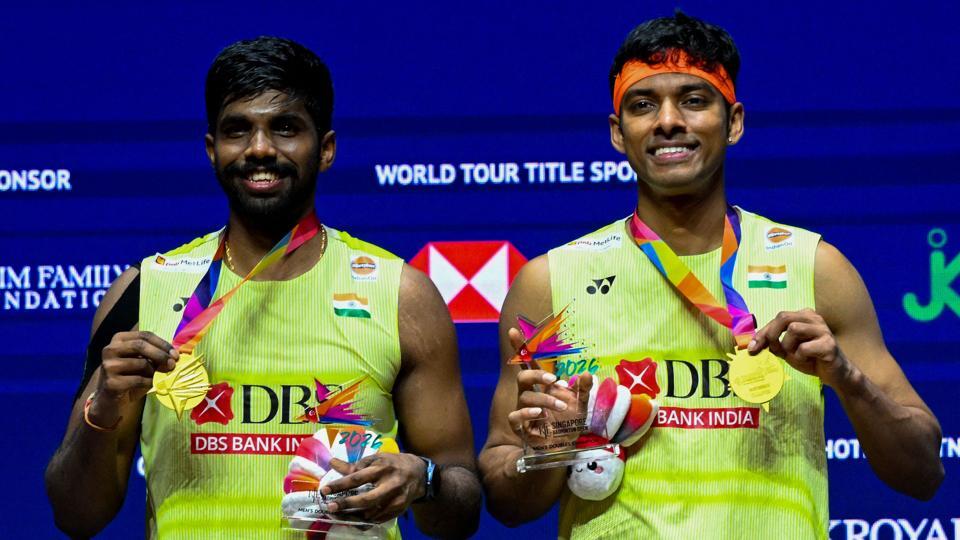
But behind their trailblazing achievements lies a critical question facing Indian badminton: what comes after the ace pair?
Building a sustainable supply chain of world-class doubles pairs remains one of the most pressing challenges for Indian badminton. Chief national coach Pullela Gopichand believes that securing the future of Indian doubles requires early talent specialisation, central coordination, and a comprehensive overhaul of the national coaching framework.
For decades, Indian badminton has operated under a heavy singles-centric system. Young shuttlers overwhelmingly aspire to follow in the footsteps of singles greats like Saina Nehwal or PV Sindhu, leaving doubles as a secondary alternative.
To create a supply chain of elite doubles pairs, Gopichand emphasises that players and coaches must make deliberate, early interventions rather than waiting for players to fall back on doubles later in their careers.
“Younger age specialisations are important. It is also important that people pick doubles as a sport. Very rarely do we have a decent singles player pick doubles if he is good at that. Not very often do you see that switch and that is an important switch to happen,” says the former All England champion.
The 52-year-old adds that several of India’s biggest success stories in both singles and doubles stemmed from decisive, top-down coaching calls rather than individual player preferences.
“For example, Satwik has been with me for the last 14 years. When Satwik came up, I said not singles, you have to play doubles. Or say, (Kidambi) Srikanth was playing mixed doubles and I said, no, you have to play singles,” said Gopichand.
“Gayatri (Gopichand) was selected for the (2018) Asian Games in singles. And then after that I said, no, you are better off playing doubles. So sometimes the conscious choice to move players from singles to doubles is an important one.”
The Dronacharya awardee recalls a similar intervention with Ashwini Ponnappa in 2006 when she was playing singles, saying that “to make that shift, somebody come up and say that confidently, that’s an important thing.”
A major factor in changing player attitudes is the presence of role models. While youngsters idolise stars like Saina and Sindhu, the unprecedented success of Satwik and Chirag has proven that doubles offers equal avenues for acclaim.
“Somehow in our country, singles still seems to be a priority. Sometimes good talent doesn’t come which could be exceptional, good talent for singles but exceptional talent for doubles,” adds Gopichand.
“We need influences like this and results from Satwik-Chirag. I don’t want to end up saying I want to become like Sindhu or Lakshya (Sen) or Srikanth, but you would also want to be like Satwik-Chirag. That’s an important shift.”
Beyond mindset, structural fragmentation poses a formidable challenge. Over the past five years, India’s badminton footprint has expanded dramatically from “4-5 prominent academies to over 500, housing roughly 5,000 independent players”. While this boom reflects unprecedented grassroots interest, it creates logjams when trying to pair compatible players across different regions and private setups.
“We are very democratic in that setup. When you come to doubles, that compounds the problem because how do you manage this?” asks Gopichand.
Forming elite doubles combinations requires bringing together complementary skill sets that may not exist within a single academy or state.
“The second thing is to find the best players. If a good player from Haryana has to play with a good player from Kerala, how do you mix both of them and make them play as a combination? Chirag was playing with MR Arjun and Satwik was playing with Krishna Prasad. Since both of them were training with me, I could actually instrument that (change), but if that was not the case and if they were not part of the national camp then we can’t actually do that,” said Gopichand.
This dynamic underscores where the broader system urgently requires attention. Junior participation has skyrocketed, with recent U-15 and U-17 national tournaments drawing over 4,200 entries alongside massive turnouts in U-11 and U-13 divisions. However, the administrative and technical infrastructure has been overwhelmed by the sheer volume.
“We are terribly understaffed in coaches and terribly understaffed in systems. And our tournament structure needs to be upgraded very frequently because the numbers are getting higher every year,” Gopichand admits.
Asked to identify the immediate priorities for Indian badminton, he mentioned two essential elements, “Of all the things which are important, if I were to pick the important things, I would say coaching is an important aspect. Systems engineering would be another. How do you get the best players to train together in a systematic format?”
While India’s prospect at the Worlds looks competitive, the country’s long-term standing in world badminton hinges on structural reform. Bridging the gap to the world’s elite requires turning grassroots numbers into an engineered system, one that identifies doubles talent early, connects top players across academy lines, and provides the coaching calibre required to form the next Satwik-Chirag.