


For six seasons, Ultimate Table Tennis ran the same way every other table tennis tournament in the world operated for decades — on the eyes and instinct of the umpire in the chair. This year, that changed. When UTT Season 7 got underway in Goa last month, matches, for the first time, were backed by an AI system that could rule on a contested serve in under 20 seconds. The Table Tennis Review (TTR), built by Gurugram-based Stupa Sports, made UTT only the second table tennis league in the world to adopt a dedicated AI review system for officiating.
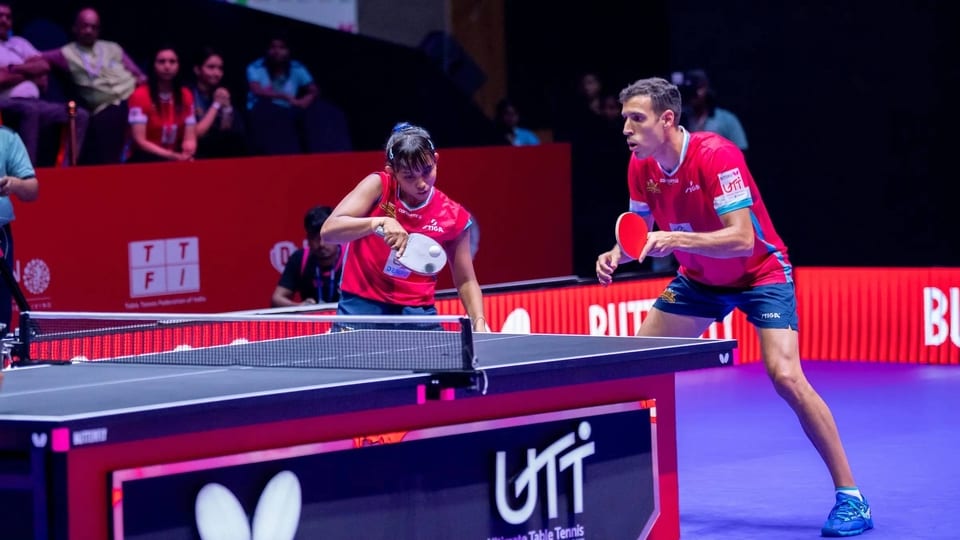
Since the third season in 2019, Stupa has been UTT’s data and technology partner. A season later, the sports technology company built the league’s AI-powered live statistics and scoring system, then added shot-speed analytics in Season 5, steadily expanding from managing UTT’s data ecosystem into shaping how matches are consumed by broadcasters and fans. TTR was the next, and perhaps the biggest, step.
ALSO READ: Inside TTR: How table tennis got its own DRS — and what it’s actually shown so far at UTT
The scale of that step becomes clearer when set against Stupa’s own calendar this year. In March, its Instant Review System (IRS) for badminton was certified by the Badminton World Federation with 99 per cent accuracy, clearing the federation’s 98 per cent threshold and making Stupa the only Indian technology provider to hold that certification. Three months later, Stupa Sports took its first giant leap beyond racquet-ball sports as it ventured into Rugby. In the second season of the Rugby Premier League in Hyderabad, the Advanced Decision Review System (ADRS) went live. And in July, TTR arrived at UTT. Three AI officiating systems, across three different sports, inside the same six months, each carrying its own technical demands and its own margin for error.
With UTT’s season over, Megha Gambhir, Founder and CEO of Stupa Sports, spoke to Hindustan Times on what a full competitive season taught the company that a pilot never could, why rugby was a natural next step and not a detour, and why officiating, once a side project, is now central to how Stupa sees its own business. Here are excerpts:
Q) UTT’s season ended recently, and TTR has now been through a full competitive season rather than a pilot. What did real match pressure teach you that the testing phase couldn’t?
The biggest difference between testing and a live competitive season is that there is no controlled environment once the tournament begins. In a pilot, you can test different scenarios, fine-tune the system and understand how the technology behaves under specific conditions. A full competitive season puts the technology into the real rhythm and pressure of professional sport, where decisions have to be accurate, fast and dependable every single time.
TTR’s deployment through UTT gave us that validation. We learnt that building an AI-based officiating system is not only about achieving high accuracy in a controlled environment; it is about making the entire system robust enough to work consistently across different players, playing styles, match situations, lighting conditions and venues, while fitting seamlessly into the workflow of officials and the broadcast.
The season also reinforced the importance of speed. In officiating, a technically correct decision is only useful if it can be delivered quickly enough to support the match without disrupting its flow. That real-world experience helped us further refine the system, the operational processes around it and the way the technology interacts with officials.
Most importantly, a competitive season changes the question from “Can the technology work?” to “Can it be trusted when it matters?” TTR coming through a full season of competitive pressure has given us that confidence and, equally importantly, a much clearer understanding of what it takes to take AI officiating from a successful technology demonstration to a dependable part of professional sport.
Q) TTR covers six specific officiating scenarios, while the number used at the international level is broader. What determines starting with six rather than going wider from day one? What’s the one contested call in table tennis that AI still can’t adjudicate with confidence?
Our TTR platform is capable of supporting all officiating scenarios that are applicable to table tennis. The reason we started with six scenarios is not due to a technical limitation, but because those were the scenarios prioritized by the league based on their frequency of occurrence and impact on match officiating.
Every event or federation has different operational priorities. Our approach is to configure the system according to the specific requirements of the organizer rather than deploying every possible review scenario from day one. For example, scenarios such as net-touch on serve or ball obstruction are relatively rare compared to edge ball, service legality, or other frequently challenged decisions. As a result, they were not included in the initial deployment, but the platform is designed to support them whenever required.
There aren’t any officiating scenarios that we consider beyond the capability of AI. The scope of deployment is driven by the event’s requirements rather than limitations of the technology. That said, we will continue to evolve the platform by making decisions even faster, improving accuracy, and presenting outputs in a way that is even more intuitive and easier for officials, players, and spectators to understand.
Q) Racquet sports have been a core part of Stupa’s identity. What specifically triggered the move into rugby? What’s guiding the choice of which sport comes next?
Racquet sports have been central to Stupa’s journey, but the underlying technology we have built is not limited to racquet sports. As the sports industry continues to digitise, we see significant synergies between the technology we have developed and the requirements of other sports.
Whether it is AI-powered statistics and graphics, officiating technology, competition management or digital platforms, the fundamental technology framework remains largely similar across sports. The sport-specific layer — such as scoring logic, rules, match structures and the metrics that matter — can then be adapted to the requirements of each discipline. Having built a strong technology foundation across multiple racquet sports, we are therefore in a position to extend these capabilities into other sports without having to reinvent the underlying infrastructure each time.
Rugby is a natural extension of that approach, and our move into the sport is driven by the opportunity to apply our existing capabilities to a new set of sporting requirements. At the same time, we do not look at expansion as simply entering as many sports as possible. The choice of what comes next is guided by two key factors: where we see the strongest technology and product synergy, and where there is genuine market demand.
Ultimately, our objective is to build technology that can adapt to the evolving needs of sport. Racquet sports gave us a strong foundation, and that foundation now allows us to explore and support a much broader sporting ecosystem.
Q) These systems are positioned as more cost-effective than what’s already on the market. What got stripped out of the traditional review-system model to get there? Does it mean it could be pushed for domestic events as well?
Our approach has been to make advanced officiating technology more accessible without compromising on the core capabilities of the system. The cost advantage comes less from stripping away functionality and more from rethinking how the technology is deployed.
We have consciously worked on a more efficient deployment model, particularly by reducing the amount of specialised hardware and equipment required. The computer vision and AI models remain at the core of the system, while the overall setup is designed to be more practical and economical to deploy. This makes the technology more accessible to organisers who may not have the budgets or infrastructure associated with the highest level of professional events.
We believe this is important because digitisation in sport should not be limited to elite competitions. The real impact of technology comes when it reaches athletes, officials and organisers across the wider sporting ecosystem. Therefore, from the outset, our intent has been to build solutions that can eventually be deployed not only at major international events but also at domestic and lower-tier competitions.
The objective is to make sophisticated technology more scalable and accessible, so that the benefits of better officiating, data and analytics can reach a much broader base of the sporting community.
Q) With TTR, IRS and ADRS all live simultaneously, where does officiating now sit in Stupa’s business?
Officiating has become a major pillar of Stupa’s business and an important part of our broader sports technology offering. What started as a capability we developed within our technology ecosystem has now evolved into solutions being deployed across multiple sports and competition levels.
In badminton, our IRS technology has been homologated by the BWF, making Stupa the only Indian technology provider to receive this recognition. We have subsequently expanded our officiating capabilities into pickleball, where our DRS technology has been deployed across multiple competitions, including the English Open 2026, events in Vietnam and PCL Asia. In table tennis, TTR has now been successfully introduced through UTT, bringing AI-powered technology into the officiating process at one of India’s leading table tennis competitions.
We are also exploring the application of these capabilities in other sports, including padel, where we are working towards a larger proof of concept for DRS and TTR.
From a business perspective, we see significant potential in officiating because it directly addresses one of the most important aspects of competitive sport — ensuring fair and accurate decision-making. By combining computer vision, AI and real-time data, these systems can support officials with precise, technology-assisted decisions while also creating greater consistency and transparency.
As we continue to expand across sports, officiating is therefore no longer an adjacent offering for Stupa; it has become one of the core pillars of our business and our vision for the future of sports technology.
Q) Stupa also builds performance analytics products alongside TTR. Can — and how can — the same match data used for officiating decisions be repackaged as insights for players and coaches, feeding players their own game back to them? Does it stand the same for badminton and rugby as well?
The same match data captured through officiating and tracking systems can be repurposed into meaningful performance insights for players and coaches. The key is to move beyond simply determining what happened in a match and use that data to understand why it happened and where a player or team can improve.
For example, in table tennis, data captured through TTR and other tracking technologies can be built into insights around patterns of play, shot selection, placement, movement and other performance indicators. This can give players and coaches a more objective view of their game and help them identify strengths, weaknesses and areas for improvement.
The underlying approach can certainly extend to sports such as badminton and rugby as well. However, the insights and metrics need to be tailored to the specific nature of each sport. Badminton, as a racket sport, would focus on very different performance parameters from rugby, which is a team sport involving positioning, movement, phases of play and team dynamics.
So, while the same principle of converting match data into actionable performance intelligence applies across sports, the analytics layer has to be built around the nuances and requirements of each sport. This is where the combination of automated data capture, AI and sport-specific analytics can create value beyond officiating — effectively giving athletes and coaches their own game back as a tool for learning and improvement.