


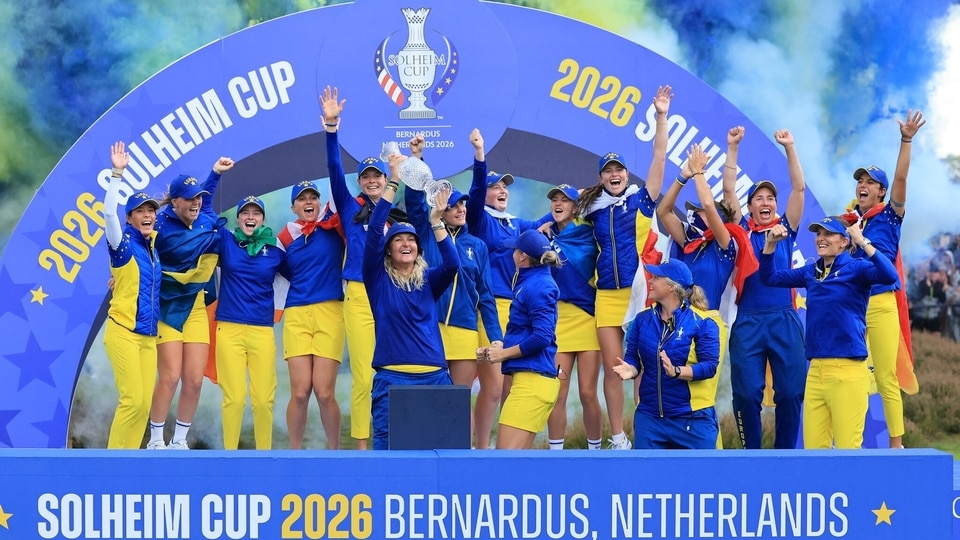
As always, match play delivers. The last two weeks have been exhilarating, even for fans who are not involved as participating teams. It started with a thrilling finish to the Walker Cup – down to the last match on the 18th hole – and then the brilliant European win in the Solheim Cup.
I’d say bring on the Presidents Cup (next week at Medinah Country Club), but the International team has proved in the past that they are no match for the United States. It will have to be another Miracle at Medinah if they were to reverse that trend.
Three team match play events in four weeks, and coming right on the heels of the announcement by the PGA Tour that they will be changing the format of the Tour Championship to a two-week match play event, is great news for the real golf fans.
Golf was always supposed to be played mano-a-mano. There was no concept of par for a hole before the late 18th century. You played against someone, strokes were counted, and the holes were either won, lost, or halved.
Personally, I love strokeplay. It makes golf unique in individual sports. Unlike tennis or badminton, where you are up against a single opponent each round, strokeplay involves a player going up against the whole field. It is a very tough format to win.
Even someone as generational as Tiger Woods won 82 titles in 378 PGA Tour starts. That’s a career percentage of 21.7. Someone as dominant as Scottie Scheffler is way below Woods’ level at 12.9 per cent (22 titles in 170 starts).
Because you have to play four rounds, the cream somehow finds its way to the top. One bad round in strokeplay can be overcome. But that’s not the case in match play. One bad round, and you are out.
So many superstars have been knocked out in the first few rounds that it became a problem for sponsors and TV ratings. There is a higher probability that Woods will be in contention in a strokeplay event than him reaching the final of a match play.
Team match play adds another layer of sophistication to it all. It gets the crowd involved. It just ratchets up the pressure on players, who are no longer playing for themselves. It calls for numerous strategies – whom to pair together, the order of play, which players to sit out… It’s fascinating.
LIV Golf did embrace the team format, but it wasn’t exactly match play in a majority of their tournaments. And yet, with all four scores counting towards the team score, we had some rollicking tournaments with momentum shifting with every shot. The teams didn’t have a clear definition early on, and it is a pity the first iteration of the League folded just as fans were accepting it.
India has led the way in this regard.
It’s a matter of pride that the domestic DP World-PGTI Tour became the first official Tour in the world to adopt a team match play event as part of its calendar. Launched last year with the first edition in February with six teams, 72 The League delivered all the excitement it promised. It is time this becomes a norm on each Tour.
The Indian Premier Golf League (IGPL) will also use a similar team/franchise format and include an individual element. 72 The League is a 100 per cent team match play event that includes foursomes, fourballs and singles.
The closest we come to team match play on the regular PGA Tour schedule is the Zurich Classic, and the Dow Championship on the LPGA. They always throw up some outstanding pairings – like Zurich winners brothers Alex and Matt Fitzpatrick this year, or Aaron Rai and Sahith Theegala with their Indian roots.
The one tournament I used to love was the Alfred Dunhill Cup. It involved 16 countries, each fielding a three-man team. The 1996 edition is a sentimental favourite because it truly put India – represented by Jeev Milkha Singh, Gaurav Ghei and Ali Sher – in the international spotlight.
In the opening round, India lost narrowly to Zimbabwe (with Nick Price, Tony Johnstone and Mark McNulty, they were a formidable team). However, on day two, October 11, they beat a Colin Montgomerie-led Scotland, the home team at the Home of Golf.
True-blue match play events are even more rare. It died when the PGA Tour put the World Golf Championship to bed. The last few editions of that tournament, as well as the new format at the Tour Championship, will feature round-robin group matches. Not the best version of match play, but at least it provides a good mix for fans, TV, and sponsors.