


As the Indian mixed compound team of 21-year-old Chikitha Taniparthi and 25-year-old Sahil Jadhav won the gold with a shoot-off win over the Korean team of Park Jeong-yun and Choi Yonghee in Asian Games in Japan on Wednesday and earned the LA Olympics quota for India for the event making its debut in Olympics, two families were keeping a tab on the results of the final with bated breath.
While Chikitha Taniparthi’s father once sold his family’s rice harvester and took loans to get the bow and bear the training expenses, Jadhav’s mother sold her jewellery to get him a new compound bow to support her son’s dream.

FOLLOW: ASIAN GAMES DAY 12 LIVE UPDATES
With the pair bagging the historic berth to the LA Olympics, 51-year-old farmer Srinivas Rao along with his wife Sreelata Rao were cheering their daughter Taniparthi along with Jadhav, from their home in Sultanpur village in Peddapalli district in Telangana.
“We stay in the small village of Sultanpur and only have our 2 acre farmland, where we grow rice. It was Chikitha, who played karate earning a black belt at a local academy, who read about an archer in a newspaper and wanted to pursue archery,” her father recalled.
- 01
How can learning karate help in archery later?
A small but important detail in this story on Chikitha Thaniparthi. Chikitha’s first brush with sport was in martial arts. She learnt karate and went right up to black belt.
How does it help in archery, you might ask.
Archery is a stationary sport. Prizes stillness. Demands extreme mental strength, concentration. There is a rhythm that elite sport demands — where your heart rate could be off the charts, but you need to nail that one trigger or arrow releasing movement, which still needs shoulder power. To get that balance right, many athletes train in martial arts – karate, judo, jiu Jitsu, to achieve absolute mental poise / strength in that moment. Precision in imbalanced positions is the goal. It’s why a Karate black belt can translate into an Asiad gold many many years later. It is mind training that becomes muscle memory.
Saina Nehwal did it in badminton. But Chikitha has gone all the way to gold.
“After her training for more than a year, I sold our rice harvester to get her a new bow as well as took loans from the village friends and others at a low interest to support her training. All in our family have been rice farmers and to see Chikitha win a gold medal as well as get the Olympics quota for India is a special feeling for us as well as the whole village,” 51-year-old Rao told The Indian Express.
Rao would take his daughter to a nearby town to train along with a local archer for a year and would also set targets made of card boxes and archery target cloth at the empty space behind their home to help his daughter practice.
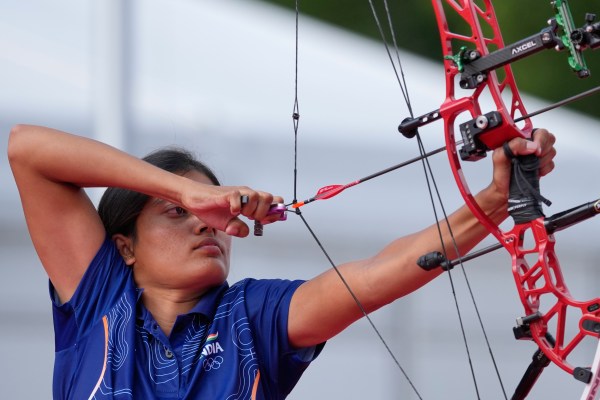 Chikitha Taniparthi during the Mixed Team final. (AP Photo/Eugene Hoshiko)
With the nearest big town being Karimnagar and the village seeing no archer or any sports shop, the father also recalls how they lost more than 1.5 lakhs in trying to get new equipment. “I would take her to the town to make Chikitha train with a local archer. And in her free time, she would shoot with the makeshift targets at the empty space besides our house. The first compound bow we tried to get, we lost the money amounting to Rs 1.5 lakh in fraud. After a year, I took a loan of Rs 3.5 lakh to get her a new bow and later when she won the sub-junior nationals, the Collector of our district got her a new bow from the government funds,” he recalls. “Later, we decided to travel to Delhi to seek training and it was there that we met international archer Abhishek Verma, who supported Chikitha and mentored her and later she got selected for the SAI Centre in Sonepat,” recalls Rao.
Story continues below this ad
For Sahil Jadhav, the initiation in archery began with a summer camp in Wai, Satara district in Maharashtra. Jadhav, whose father Rajesh Jadhav works as a service executive in a car company workshop, along with his wife Seema Jadhav later got the youngster enrolled at the academy under coach Pravin Sawant, who had coached the likes of world champions Aditi Swami and Ojas Deotale.
The youngster would start competing in Indian rounds with the family getting him a wooden bow and later his mother selling her jewellery to get him a new compound bow. “It was at a summer camp under coach Bhiese that Sahil first tried archery. We wanted him to try an individual sport and sent him to the camp. Later his interest developed but I told him that we will do whatever we can do to support him. We got him enrolled at Pravin Sawant sir’s academy and my wife would sell her jewellery to get him a new compound bow a year later,” shares father Rajesh Jadhav.
While Jadhav would train at the academy initially trying Indian round archery before also trying his hand in recurve followed by coach Sawant deciding to put him in compound.
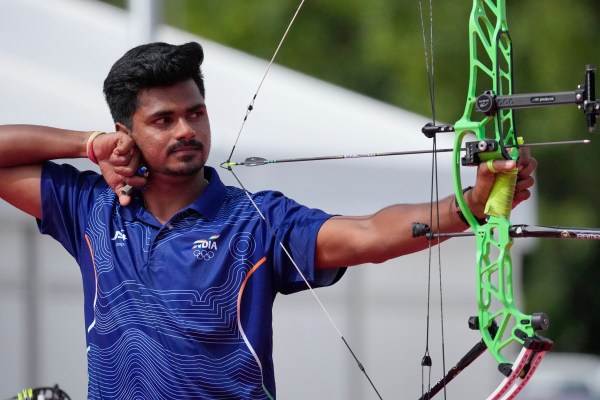 Sahil Jadhav during the compound mixed team final, Wednesday. (AP Photo/Eugene Hoshiko)
The youngster would train for some years under Sawant before he was selected for the Sports Authority of India (SAI) National Centre of Excellence (NCOE), Eastern Centre in Kolkata. “Initially Sahil trained in wooden rounds before we tried putting him in recurve. But he would face troubles since his body did not make a T-Shape, a necessity in recurve and we decided to shift him to the compound. His upper back and shoulder muscles were strong and Sahil would pick up things in compound with ease and at a quick pace,” shares Sawant.
Story continues below this ad
In 2020, Rajesh Jadhav lost his job and with his wife working as a teacher, it was a tough phase for the family. At that time, Sahil had not joined the Kolkata centre and Rajesh Jadhav took up a job in a nearby town at a much lower wage months later to support his son’s dream.
“During Covid-19, I lost my job. For 3-4 months, I was without a job and it was a tough phase for the family with only my wife earning a meagre salary from her job. Sometimes, we would see Sahil training with old arrows with the arrow bending during the shooting and I would get emotional seeing all that. When I got the job in another two months on a much lower wage, I told Sahil that whatever we could do, we will try and you just don’t lose hope and keep practicing and training. Later, when he got selected in the SAI Centre at Kolkata, things got easier for us in terms of his training.”
When he won the title in senior nationals in 2024 followed by his title in the World University Games in Germany last year, he would call them with his gold medal. “This medal is all due to his persistence amid the tough situation for the whole family,” says Rajesh Jadhav.
As for the Rao family, they know what their daughter will do post her arrival with the gold medal. “Chikitha shared that she wants to get a new rice harvester for the family. And with the prize money, that’s the first thing she will do. Apart from that, she likes having the Chitti Muthyalu rice, which is also called Small Pearls. With this gold medal, she is the pearl of our village and family,” says Rao.
Story continues below this ad
The Indians were tied on 157-157 after the end of the fourth round before the shoot-off happened. Chikitha hit a ten followed by the Korean too hitting a ten. Sahil then hit a close ten before the Korean missed as the Indians won the shoot-off 20-19 to seal the title and Olympics quota.


