


The scoreboard still read 25-18, the final point of Pakistan’s 3-0 win over India. But as Amit Balwan Singh stood talking about the defeat, Pakistan’s middle blocker Musaweer Khan ruffled his hair, Murad Khan consoled him and Abu Bakar Siddique walked over and patted him on the back. “The Indian players are like my brothers,” Siddique said.
It was a gentle end to a match Pakistan had dominated, on a day that offered two different India-Pakistan results across two sports. In the morning, Pakistan beat India 3-0 in volleyball. In the evening, India beat Pakistan 4-3 in hockey — a semifinal that provided a glimpse of what the rivalry between the two could still produce, with players high-fiving each other before the push-back and captains shaking hands at the start.

The two countries will meet again on Saturday, this time for the Asian Games cricket gold medal. There, the customary handshake has been absent in recent meetings, offering a different picture of the rivalry.
Asked in the context of the cricket teams’ decision not to shake hands, Amit, an outside-hitter, said: “People look at India-Pakistan from a different point of view. But a sportsperson has to think about his best performance. The relations (between the two countries) haven’t been good since the beginning but a sportsperson has to ignore all that and focus on the game.”
Click here to read our Asian Games full coverage
The volleyball court offered a glimpse of what he meant. Before the quarterfinal match, the teams exchanged pins and greeted each other. Once the whistle went, however, the familiarity gave way to the contest, with Pakistan attacking more cleanly and repeatedly finding ways around India’s block. Pakistan took the first set 25-19, fought back from 16-13 down to take the second 25-23 and then pulled away early in the third to win 25-18.
The intensity was obvious during the match. Pakistan celebrated almost every point loudly, especially as India began to struggle in the third set. But the mood changed quickly once the contest ended. “We were relaxed throughout,” Siddique said, as Pakistan recorded a third straight win over India at the Asian Games.
At 19, Siddique is one of the younger players in the Pakistan team. Sharing the athletes’ accommodation with the Indian side, he said, had given him a chance to learn from players he had previously known mainly as opponents. “We are staying at the same hotel. I am a junior, so I learn a lot just by watching how they conduct themselves. What they eat, what they do, how they kit up. It feels very good to share space with seniors. We all eat together at the mess,” he said.
Story continues below this ad
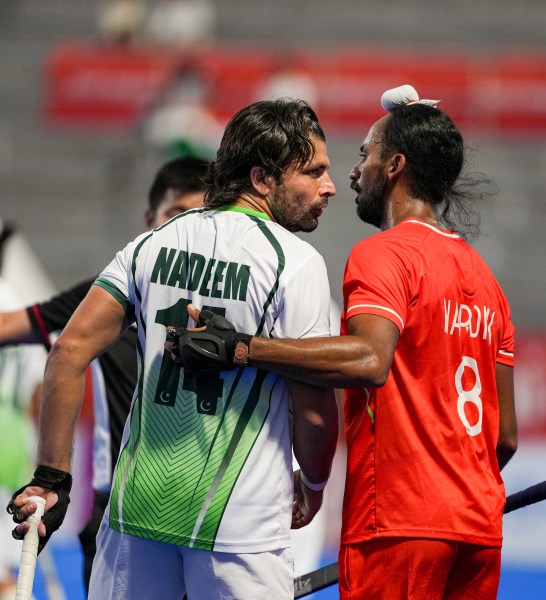 India’s Hardik Singh with Pakistan’s Nadeem Ahmad during the men’s semifinal hockey match. (PTI)
Siddique also spoke about Indian players with the familiarity of someone discussing teammates rather than rivals. “Mashallah, all Indian players are good. I have seen Chirag (Yadav, an outside-hitter) a lot, there’s Muthuswamy (Appavu, a setter). Mashallah, he is also good. At CAVA (Nations League, last year when India had won), he was very good, outstanding. I saw him and wondered, ‘yeh kya kar raha hai (what is he doing)’!”
There is, of course, an awareness among the players of what an India-Pakistan fixture represents beyond the court. Abu Bakar said the hype surrounding the matches was largely a product of the rivalry built around them.
“Of course, there is hype when India and Pakistan play. But that’s because of the way this rivalry has been turned into animosity. So that’s what stays with us, India-Pakistan, India-Pakistan. But trust me, our two teams have a very good relationship, gupshup karte hai (we do have chats),” he said.
There is familiarity and respect also because the players face each other in club colours. Indian and Pakistani spikers often ply their trade in volleyball leagues in central Asia. And, sharing a neutral ground has helped players understand each other better. “I know Amit because we played two years ago together in Kazakhstan,” said Khan, who hails from Pakistan’s volleyball-crazy district of Bannu, in Khyber Pakhtunkhwa. “What happens outside sport does not reflect on our relationship when we play.”
Story continues below this ad
Amit, who has played alongside Pakistani players at clubs in Iran, made the same distinction. “This is, of course, a very important match. As a sportsperson, if we look at this match from that point of view, there will be more pressure. We can execute our skills if we play with a free mind. Out of the court, we speak to each other cordially. Sometimes, we end up playing for the same clubs abroad, like in Iran,” he said.
A few hours later, the result was reversed on the hockey field, but the drama was turned up several notches. India raced to a 3-0 lead, only for Pakistan to fight back and level the match at 3-3. With 49.2 seconds left, forward Abhishek Nain’s shot took a deflection off Sufiyan Khan’s stick and found the net for a thrilling 4-3 win and sent India into Saturday’s final, where they will face Malaysia.
When the match ended, the players, exhausted and overcome by emotion, shook hands before leaving the field.
The hockey and volleyball players were not alone. Earlier in the Games, the India and Pakistan table tennis players, too, greeted each other warmly, as did their squash players.
Story continues below this ad
On Thursday, even as the results went one way in the morning and the other in the evening, the warmth stayed the same.


