


There has been plenty of chatter during the Asian Games about naturalised athletes from Africa winning medals for their adopted countries in athletics events. This is not the first time it has happened, either.
For the past few editions of the Asian Games, athletes from Bahrain and Qatar – two countries that have widely used a policy of naturalisation to fuel their respective athletics contingents – have staked a claim over the medals in the track disciplines in particular.
It has often raised questions over the fairness of such a policy by rival Asian countries, as athletes coming from countries like Kenya, Nigeria and Ethiopia – powerhouses in track and distance running – have been changing the scales.
Is the move legal?
Yes, it is. There are no laws across sports that suggest athletes cannot change their nationality and represent their adopted country.
Each adoptive country has their own immigration rules and regulations. Bahrain’s rules generally state that non-Arabs must reside in the country for at least 20 consecutive years before becoming eligible to apply for citizenship.
Those rules are different and fast-tracked for athletes; however, they remain legal and at the discretion of the adopting nation.
Can athletes compete immediately after changing nationality?
No, there is a waiting period that varies depending on the level of the athlete.
According to Rule 52 of the Olympic Council of Asia (OCA), an athlete has to be a national of the country they represent. A bylaw of the same rule states that: “A competitor who has represented one country in the Olympic Games, OCA (Asian) Games, continental, regional, and world championships recognised by the relevant IF (international federation), and who has changed his nationality or acquired a new nationality, shall not participate in the OCA Games to represent his new country until three years after such change or acquisition.”
A similar waiting period applies to athletes who have already competed in events like the Olympic Games while representing their country of birth before they can represent their new country at another Olympics, according to Rule 41 of the Olympic Charter.
Athletes are, however, allowed to appeal for the three-year period to be reduced.
For athletes who have not represented their birth country in any of the major events though, the process becomes more streamlined to apply for eligibility to compete for their new nation at those events.
That is why countries like Bahrain have used a strong scouting program to find unheralded talent that can make the switch and then train them, rather than approach established runners.
“It is not nationality that brings us medals, but the training and technical and administrative effort,” Bader Nasser, then manager of the Bahrain Athletics Federation and current financial secretary of the association, told AFP at the 2018 Asian Games.
“Naturalisation is a legitimate right and we are committed to the laws.”
He further added that Bahrain has been “bringing them young and training them to reach world championships”.
What has been the impact?
The policy of neutralising athletes has made Bahrain one of the major players in the Asian athletics field.
As of the morning of September 28, Bahrain had won seven gold and two bronze medals in athletics at the 2026 Asian Games. None of those medallists from individual events though were born in Bahrain.
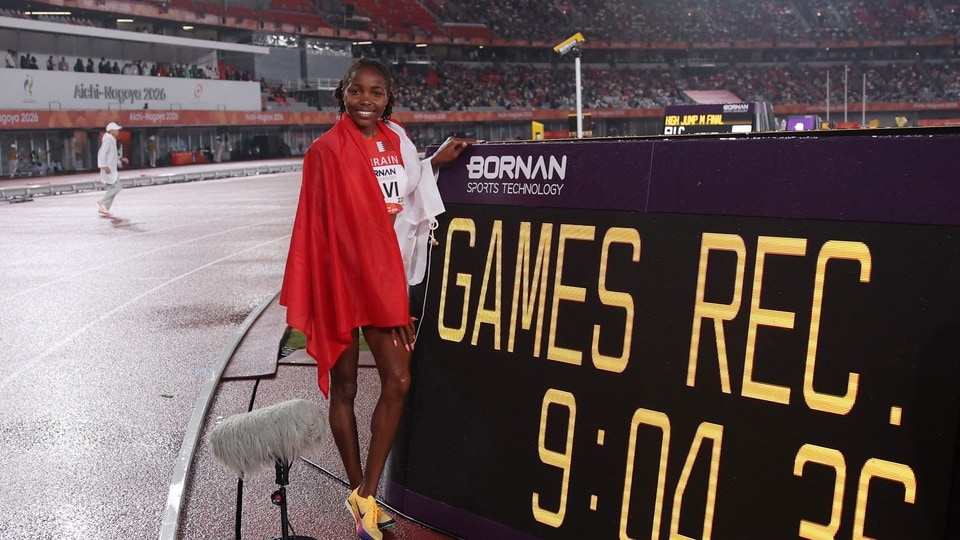
This includes Kenya-born Winfred Yavi, the reigning 3000m steeplechase Olympic champion, who has won gold in the steeplechase and women’s 5000m event races at this Asian Games.
Additionally, in the top 10 list of men’s 5000m runners, Saudi Arabia’s Moukhled Al Outaibi and India’s Gulveer Singh are the only runners born in the countries they represent.


