


London: From the start, Formula E has been a championship defined by evolution. As the Gen3 era – initially met with skepticism but ultimately defined by record-breaking racing – concluded on Sunday, the paddock is already bracing for the next big leap.
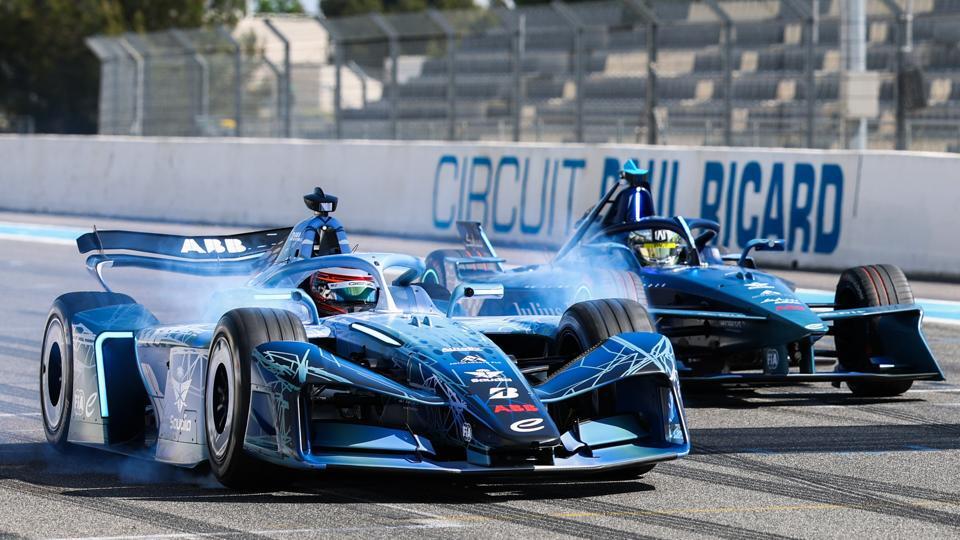
The impending Gen4 era promises to fundamentally rewrite the rulebook for electric motorsport. Reflecting on the outgoing machinery, Formula E co-founder and chief championship officer Alberto Longo is proud of what the series has accomplished so far.
“People had doubts about Gen3, about the look and feel, about the performance of the car. The reality after four years… it has been a massive success. There have been some double-headers where we’ve seen more than 600 overtakes over the course of two days.”
Yet, in the hyper-innovative world of EV technology, resting on laurels is impossible. “The afternoon (we launched Gen3), we had a meeting already to start talking about Gen4,” reveals Longo, admitting the series is already in active discussions regarding Gen5.
But what separates the outgoing machines from Gen4? Brute force, aerodynamic grip, and staggering pace. While Gen3 (2022-2026) focused on lightweight agility and efficiency, Gen4 introduces much more power, enhanced tyres, and a massive increase in downforce.
While Gen3 cars had a maximum power output of 350kW (470bhp), the Gen4 machinery (to be used from 2026-203) will deliver 600kW (804bhp) with a projected top speed of 350kph.
“I didn’t like that generation (Gen3) of cars at all. Right from the start, it’s been proving to be quite tricky for me. Gen4 is a car that is a lot more fun to drive. You have more downforce and power,” Mahindra Racing’s Edoardo Mortara said here.
This leap has already caught the attention of the wider motorsport elite. During the Monaco E-Prix, several F1 drivers praised the Gen4 machinery.
The sheer speed, width, and aerodynamic dependency of the Gen4 cars necessitate an evolution in where Formula E races. Originally conceived as a tight, inner-city street racing series, Gen4’s physical performance is forcing a shift towards permanent facilities.
Andretti’s Felipe Drugovich agrees with the shift, adding that “moving to greater and better tracks is the goal.” It is a sentiment echoed by Mortara.
The Gen4 car will be larger and heavier than Gen3 across all key dimensions to accommodate a larger 55kW battery, dual-motor all-wheel-drive powertrain. The Gen4 expands in overall length to 5,540mm (up by 439–520mm), width to 1,800mm (compared to Gen3’s 1,707mm), and stretches its wheelbase to 3,080mm (up from 2,705mm).
The car’s weight increases from Gen3’s 863 kg (including driver) to a minimum of 950–1,016 kg for Gen4.
The engineering arms race is ferocious. Gen4 introduces a “joker” token system, allowing teams an opportunity to push major development upgrades during the cycle. For teams like Mahindra, who started testing later than their rivals, the learning curve is exceptionally steep.
Regarding the joker system, Mortara remains pragmatic, viewing it as a one-shot bullet. “As soon as you use your joker, then that’s it for the remainder of the Gen4 era,” said the Swiss.
As Formula E bids farewell to Gen3, Gen4 stands as a bold leap into the unknown, promising F1 rivalling speeds, high-stakes development battles, and a completely redefined style of electric racing.