


In the village of Povoacao Velha on the island of Boa Vista, there was one television set. Not one per street. One. On World Cup nights, the neighbours gathered around it, and a boy called Pedro Leitao Brito watched Maradona and Matthaus.
His mother made footballs from socks.
Pedro Leitao Brito grew up to captain Cape Verde for 11 years. He is now known as Bubista, the Creole name for the island where he was born. On Friday night in Houston, at 56 years old, he stood on the touchline and watched his country reach the knockout rounds of the World Cup for the first time. Cape Verde drew 0-0 with Saudi Arabia. In Guadalajara, simultaneously, Spain beat Uruguay 1-0. The Blue Sharks went through as group runners-up. In their first World Cup. At the seventh attempt to qualify for one.
This is what twenty years of patient work looks like from the outside. From the inside it looks like Logan Costa.
ALSO READ | ‘The Voice’ in the Cape Verde goal: Vozinha, who made 7 saves against Spain
The centre-back from Villarreal is widely considered Cape Verde’s best player. In July 2025, he ruptured his ACL in pre-season. He returned to action on May 17, 2026, as a substitute, played for 13 minutes in a La Liga defeat. Thirteen minutes in 10 months. Bubista put him in the squad anyway. Costa has started all three games. Spain, Uruguay, Saudi Arabia. None of them found a way past him. He has barely looked like a man who spent most of the year watching from a physio’s table.
The midfield behind him is Jamiro Monteiro, born in Spangen, West Rotterdam, to Cape Verdean immigrant parents. He learned football on the streets of the neighbourhood. He played in the Philadelphia Union’s Supporters’ Shield season, then San Jose, then back to the Netherlands. He earned his 50th cap in the qualifier against Eswatini that sent Cape Verde to this World Cup. On Friday he ran himself into the ground for ninety minutes against Saudi Arabia and nobody particularly noticed, which is exactly what he was there to do.
Kevin Pina’s first World Cup goal, the free kick that split Uruguay’s wall in Miami, was traced afterward to a street game in Brockton, Massachusetts, where former Cape Verde captain Carlos Morais first spotted him and pointed him toward professional football. The goal came from Russia, where Pina plays for Krasnodar. The idea of it came from a pavement in New England.
Story continues below this ad
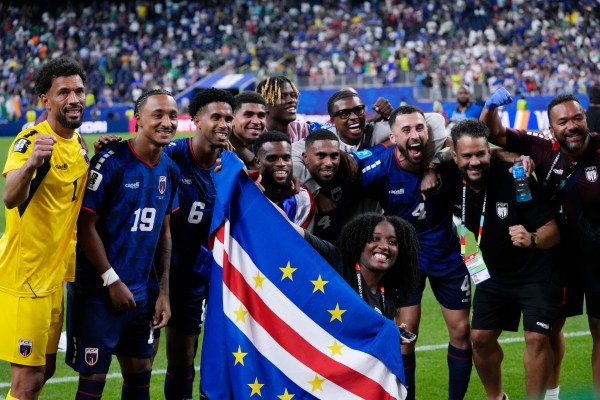 Cape Verde players celebrate after their Round of 32 qualification on Friday. (AP Photo/David J. Phillip)
Helio Varela is 24. He plays for Maccabi Tel Aviv. He came off the bench against Uruguay, had been on the pitch minutes, and equalised to earn the draw that kept everything alive. His first international goal. Bubista had seen something in him that the starting eleven did not yet need to show.
You already know about Vozinha, who made seven saves against Spain and cried at the final whistle because his grandparents were gone and his mother could not afford the visa bond. You know about Pico Lopes, born in Crumlin, Dublin, who ignored a LinkedIn message in Portuguese from the Cape Verde coach because he thought it was spam and nearly missed all of this.
Ryan Mendes is 36, captain, 96 caps across 16 years. Dailon Livramento is 25. Mendes the constant across every campaign that came before, Livramento the man who scored the winner against Cameroon and opened the scoring against Eswatini, the goals that got Cape Verde here before the world was watching. Nobody made a film about those nights.
What the tournament money makes possible is a boy like Yuri Marley Fernandes. He is 14, trains at a youth academy called EPIF in Praia, and talks like someone who expects to play on the biggest stage. The Cape Verde federation will earn $10.5 million just for reaching the group stage; officials say it goes into development and scouting across the diaspora. But the real accounting is this: Yuri has grown up watching a national team that reaches AFCON quarter-finals and tops qualifying groups containing Cameroon. He has never had to imagine that a team like his could do this. He already knows.
Story continues below this ad
ALSO READ | The Ousmane Dembele show: The art of minimalism and scoring goals
On the eve of Friday’s game, Bubista told reporters: “Everyone is entitled to dream and nothing is impossible.” He did not say it like a man making a speech. He said it like a man who grew up in a village with one television set and a mother who made balls from socks, and who understands precisely what it costs to be taken seriously.
In Praia on Friday night, strangers hugged in the streets. In New England, in Rotterdam, in Lisbon, the sodade, that untranslatable longing for home, found somewhere to rest.
They face Messi’s Argentina next. The boy from Povoacao Velha has seen bigger things on a borrowed television.