


Ten days, thirty-nine medals and an overall fourth-place finish that exceeded all expectations — the Glasgow Commonwealth Games 2026 are over, and the flag has been handed over to PT Usha and Neeraj Chopra to carry to Ahmedabad for the 2030 edition.
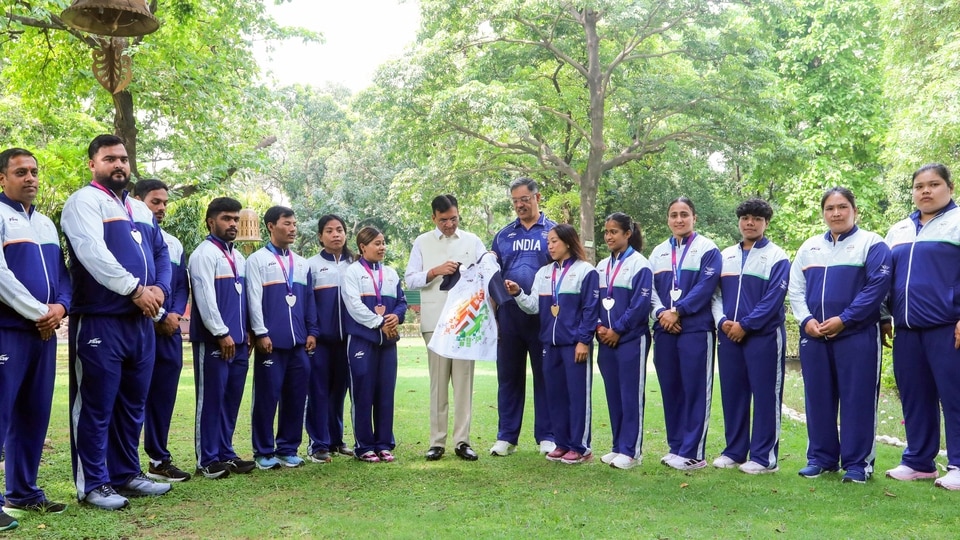
Despite a heavily trimmed sports programme that excluded traditional medal events like shooting and wrestling, India’s Glasgow campaign was defined by historic breakthroughs, shock underperformances, administrative friction, and strong hope for the future.
The best moments
Boxing’s Seven-Gold Clean Sweep: Ten of the fourteen fighters went deep into the knockouts, winning seven golds and three silvers. The previous best had been six gold medals, held by England (1934 and 2018) and Canada (1986). The women led the charge, securing five golds through Sakshi Chaudhary, Preeti Pawar, Jaismine Lamboria, Arundhati Choudhary, and Priya Ghanghas, to headline a dominant final day of the campaign.
Asmita Dey and Harsh Singh’s Landmark Judo Golds: India had never won a Commonwealth Games judo gold medal. Asmita Dey and Harsh Singh shattered that barrier in Glasgow, with Dey claiming the women’s 48kg title and Singh triumphing in the men’s 60kg division to anchor a four-medal haul.
Parasport Medal Haul: Three separate historic double podium finishes in women’s shot put F57, men’s shot put F57 and men’s 100m T47 saw India win seven medals (three golds, two silvers and two bronzes), matching the country’s combined para-sports tally from all previous editions!
The Men’s Javelin Double Podium: Neeraj Chopra was the headliner, but after an injury-plagued year, expectations were pragmatic. It mattered little as he marked his return to the CWG stage to take silver with an 85.83m throw. But it was his compatriot Yashvir Singh who provided the biggest surprise, snatching bronze with a personal best of 84.41m on his final attempt to produce a historic double podium finish. For years, Chopra has been the talismanic face of Indian athletics and the biggest name by far in javelin. Glasgow has given him Singh as both company and successor.
The shock underperformances
Lawn Bowls Contingent: Four years after a fairytale gold in Birmingham, the lawn bowls team endured a disastrous campaign in Glasgow. The shift to an indoor format proved the death knell, as the Indian campaign collapsed to adjust to the conditions. All four entries (two in singles, two in pairs) were eliminated in the early rounds without reaching the knockouts.
Gurindervir Singh: Hopes were high for India’s fastest man, who entered the competition two months on from setting a national record of 10.09 seconds at the Federation Cup in Ranchi. Instead, his tournament ended in the opening stage after he produced a sluggish time of 10.39 seconds to finish 28th overall across heats. His coach later revealed that he had been hampered by a hamstring injury, raising questions over the selection and management.
Able-Bodied Swimming: Despite a record 42 medal events, the five-member team—led by Olympians Srihari Nataraj and Sajan Prakash—struggled to match the elite competition. Nataraj reached the semi-finals in both the 50m and 100m backstroke but missed the finals, while veteran Prakash finished eighth in the 200m butterfly final and failed to advance from the 50m butterfly heats.
The heartbreaks
Para-Swimming Bureaucracy: Multiple qualified para-swimmers missed out on competition. Administrative oversights and outdated international classification review statuses, notably affecting Tejas Nandakumar, robbed athletes of their shot at the podium.
Best performer
Tejaswin Shankar (Athletics): Battling a patellar tendon injury that had forced him to pull out of the high jump event, Shankar delivered a performance for the ages in the men’s decathlon. The 27-year-old finished Day 1 in 5th place before a dramatic Day 2 saw him shuttle in and out of the podium positions, until finally, his 7,976 points saw him win bronze. He became the first Indian in history to claim a decathlon medal at the Commonwealth Games, and also India’s first track and field athlete to win medals in two different individual events across multiple CWG editions (where he won bronze in 2022).


