


Manchester United, without a permanent head coach or European football and knocked out of both domestic cups at the first time of asking, are facing another bleak season. In the almost 13 years since Sir Alex Ferguson left, the club have struggled to find stability, with his shadow stretching down from the directors’ box to the dugout, emphasised by the stand named in his honour staring back.
Manchester City arrive at Old Trafford on Saturday in the opposite position, having had Pep Guardiola in post for a decade, amassing 18 major trophies. Michael Carrick will take charge of United for the first time since being appointed until the end of the season at a club who appear to be without a functioning long-term plan. This will be a campaign of only 40 competitive games for United, their fewest since 1914-15, with some fans thankful for being able to cut down on trudging visits. So is this, in the post-Ferguson era, the lowest of the lows?
“We’ve hit more rock bottoms and broken more unwanted records in the past few years than I’d care to remember, but I wouldn’t say this is the lowest point since Sir Alex retired,” says Rick Redman, a season-ticket holder. “That was the 7-0 at Anfield, even though we finished above Liverpool that season. You could argue it was finishing 15th in the league and losing a European final to a Spurs side who had already beaten us three times that same season. This shows the overall problem. There are too many to choose from.”
Speak to United fans and the nadir varies from seat to seat. There is plenty to suit individual taste, including humbling defeats by Liverpool and City, missing European nights, a tedious style or entire managerial spells.
Nostalgia lingers at Old Trafford, especially because celebrations have been in short supply. This is the second short-term managerial spell Carrick has been thrust into. In times of crisis, the plan is often to find someone who knows the club, with talk of its DNA. Ryan Giggs, Ole Gunnar Solskjær and Ruud van Nistelrooy had their stints, and Darren Fletcher was in charge for the past two games. All sought the advice of Ferguson, ensuring a direct link between the old and the new in an attempt to go back to the future, but contemplating repeating those successes is preposterous. Instead, a realignment of ambitions has taken over the stands, if not the boardroom.
Ferguson oversaw an aeon, whereas the successors have barely found time to fill a chapter. The nine-month reign of David Moyes to start life post-Ferguson was a sign of things to come. It was never going to be easy to replace a legend but little has gone well. Louis van Gaal, José Mourinho and Erik ten Hag ran tight ships but they came with a shelf life.
No one has survived three years in the role. Solskjær lasted longest, taking charge of 168 games, and finished second in the Premier League but won no silverware and lost five of his final seven league games. The Norwegian brought back Cristiano Ronaldo to amplify the feeling of days gone by, only for his return to be remembered for its explosive ending.
James Starr, a lifelong fan, says: “Strangely, my lowest moment in recent history was either [Ralf] Rangnick’s tenure, which was defined by a dire run of results, or the second half of last season under [Ruben] Amorim. I don’t think Amorim should have been sacked; he had got rid of the deadwood and was starting to make small progress with this team. Another good summer of signings of the ilk of Bryan Mbeumo and Matheus Cunha and I think we’d have been around the Champions League spots again comfortably next season.”
Sir Jim Ratcliffe’s investment was supposed to hail a new era but that optimism is diminishing, with the Glazers still at his side. Ratcliffe claimed Amorim required three years to prove his mettle as an elite Premier League coach but the Portuguese was gone within months of the co-owner’s comments. The chief executive, Omar Berrada, and director of football, Jason Wilcox, have come under scrutiny and lacked an obvious succession plan after Amorim’s demise. The suits have plenty to prove after numerous missteps.
Starr says: “It is difficult to have faith in the hierarchy when you look at the key decisions they’ve made so far: keeping Ten Hag after the FA Cup win just to sack him a few months later, hiring and firing Dan Ashworth, neglecting our glaringly lacking midfield, and now backing Amorim then firing him seemingly without a long-term plan B.”
For all the faults in Amorim’s 14-month tenure, he left United in a promising position in the Premier League: seventh, three points off fourth. There is a clear opportunity to challenge for Champions League qualification with no distractions. Europe’s most lucrative competition has not visited this part of town for two years and the drop in revenue is critical for a club marketed as the biggest in the world but unable to get past Grimsby of League Two.
With three wins in their past 13 matches there is an immediate problem facing Carrick in front of an apathetic crowd. A derby against bitter rivals could galvanise the fanbase or sink the mood to new depths. “I can’t see the derby being anything other than a thrashing,” says Starr. United’s FA Cup final victory over City in 2024 kept Ten Hag in his job and offered hope but instability continued. Carrick is here to bring positivity as someone who won five Premier League titles at Old Trafford as a player.
Redman says: “We have to look at this season – as shambolic as it is by traditional United standards – as slow progress in terms of the league. Some of the embarrassing defeats we’ve suffered have at least been through fine margins, or referees implementing the rules differently against us. Those are excuses we shouldn’t be making, and it’s depressing that we’ve seen off yet another manager.”
Quick GuideNow for manager No 6. Guardiola’s record against Manchester United
Show
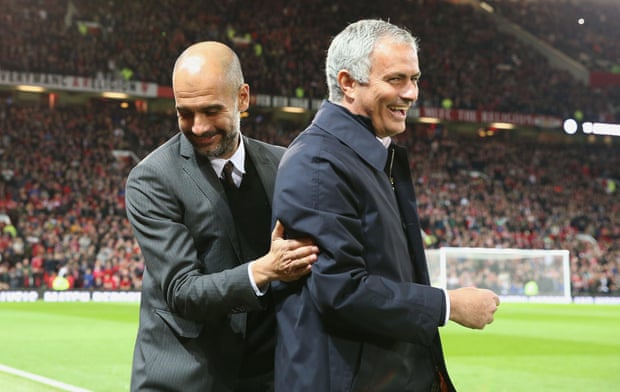
v José Mourinho (pictured)
Played 6 Won 3 Drew 1 Lost 2
v Ole Gunnar Solskjær
Played 9 Won 4 Drew 1 Lost 4
v Ralf Rangnick
Played 1 Won 1
v Erik ten Hag
Played 7 Won 4 Drew 1 Lost 2
v Ruben Amorim
Played 3 Won 1 Drew 1 Lost 1
Total: P26 W13 D4 L9
Source: Opta
Plenty of money has been spent on coaches and players in an attempt to end the malaise. Paul Pogba returned for £100m and Antony, Jadon Sancho and Romelu Lukaku each cost more than £70m but repaid very little of it before leaving. The ineptitude has been compounded by academy players being sold to make way for incomings, with Scott McTominay, Anthony Elanga and Dean Henderson going on to thrive outside the United bubble. The latest summer recruits – Cunha, Mbeumo, Benjamin Sesko and Senne Lammens – have offered hope of evolution but nothing akin to a revolution.
Carrick’s return marks the 12th permanent or temporary appointment since Ferguson’s retirement. Five trophies have been collected: two FA Cups, two League Cups and a Europa League. Under Ferguson, United never ended outside the top three in the Premier League but the past 13 years have brought eight seasons where they have finished fourth or below, culminating in coming 15th last May.
“I keep thinking back to Ralf Rangnick’s ‘open heart surgery’ comments, having analysed and explained the multitude of issues at the club,” Redman says. “His words still very much apply four years on. With the Glazers still being in power it’s more like we’ve had a pacemaker fitted, at best.” Another health check will be administered by Manchester City on Saturday.


