


Only Flavio Cobolli with the shatter-proof confidence of the pro athlete (and his family) won’t be surprised that he has reached the Roland Garros men’s singles final.
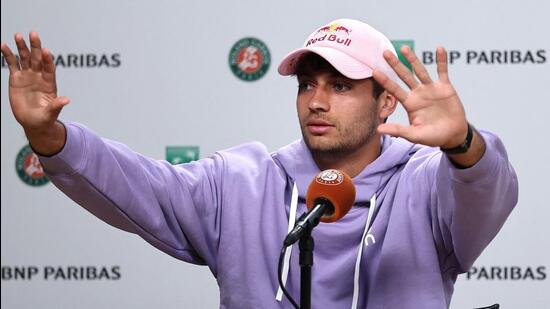
What has astonished the tennis community, including in Cobolli’s country, is not that there is an Italian in the Roland Garros men’s singles final. What has sideswiped everyone is that the Italian finalist is not called Sinner, J. Or by extension Musetti, L. It is, as the French describe it, incroyable.
But Cobolli was always third in line, behind his country’s top two. He is the only Italian not named Sinner or Musetti who has reached a Grand Slam last eight – Wimbledon 2025. The one piece of clarity to emerge from this tumultuous French Open is that the Italian tennis renaissance, or is it the naissance (birth, itself), that is taking place before our eyes.
For the first time ever, there were three Italians in a single Grand Slam quarter-final, and like Cobolli the other two weren’t household names.
Pannata and the wait
It was in the pre-Jannik Sinner era that one of this quarterfinal trifecta, Matteo Berretini, marked the earliest traces of this Italian surge when he made the 2021 Wimbledon final. Berrettini was the first Italian into a Grand Slam final after Adriano Pannata won at Roland Garros in 1976. Last year, again minus Sinner-Musetti, Cobolli and Berrettini ensured that Italy won their third straight Davis Cup title. After Pannatta had led Italy to their first-ever Davis Cup title in 1976, Italy won for the second time only in 2023, and are currently on a three-season streak.
Italy now has more players in the top ten – four – than any other country. At RG2026, it had nine in the men’s singles draw, of which three made it to the last eight – Matteo Arnaldi was the third – with their top two invisible. Musetti pulled out of Roland Garros before the event, and Sinner melted in the second round.
Despite their absence, Italy’s weight and influence in the men’s game has played out in this single Grand Slam event more than before. Gaia Piccardi, sportswriter for over 30 years with Milan daily Corriere Della Sera says that nothing of what Italians have done at RG26 is either “fairy tale or miracle”. She has termed this era as the nouvelle vague/new wave of Italian tennis.
That this has happened on the ‘terroir’ of their great cultural and sporting rivals is not lost on the Italians. No one in Roland Garros is making jokes about the football World Cup yet. Riccardo Crivelli of the La Gazetta Dello Sport says, “France had always been a model for our tennis and for many others – they produced top ten players and we weren’t capable of getting to those results. Now the situation is reversed… we have become the model for France.” He tries not to boast when he says, “We’re very pleased, even a little proud, let’s say a little embarrassed – that they look at us with a little envy.”
FITP’s reset paying off
The model that the Italians refer to is a two-decade-old overhaul. It is one of those rare occasions when a sporting federation is given full credit for the restructuring and improvement of their sport. The first focus of the FITP (Federazione Italiana Tennis e Padel) was on its junior recruitment and scouting system. Thirteen decentralised federation centres were set up nationwide to identify talent from the age of 10 plus. The athletes don’t get hauled into the centres but work with their private coaches who are in contact with their regional centre coaches. At the national tennis centre, a promising player can seek expertise and assistance if required.
The FITP lauched its free-to-air TV channel called Super Tennis in 2008 which shows tennis 24×7 365 days and buys broadcast rights for tennis events ranging from Grand Slams to Challengers. There was an increase in the number of lower-division tennis events countywide. Between February and October 2026, Italy will host 18 ATP challengers, 25 ITF world men’s and 17 women’s tennis tour events plus six WTA 125 and 11 ITF junior events.
The world tennis tour is the entry point to get into pro tennis with prize money ranging from $15k to 100k. It means playing opportunities, ranking points and more wild cards for Italians. At the highest level, Italy only stages the ATP-WTA double Italian Open and has hosted the ATP Tour finals in Turin since 2021. It hosted the Davis Cup finals for the first time in 2025, which will run through till 2030.
This nouvelle vague has gone from ripple effect to a surge and Piccardi says, “along the way, we have found Jannik…” the impact of whose ‘generational talent’ has been monumental. The senior pros around Sinner, “finally have an example and someone to look up to. If he can do it, we can do it. They see ‘what can we do to improve and be like Jannik’.” They try to train with Sinner at events they share and cannot but notice the bar being set and seek to emulate.
The big Sinner effect
Crivelli’s favourite Sinner moment was when he became world No.1 in 2024, a position no Italian had every occupied. “When you have the strongest player, it means you’ve built truly something lasting and important – for 40 years we had seen so many countries reaching the top – but we had not seen that for us.”
Piccardi’s is the 2025 Wimbledon victory. “It’s iconic, like winning the Oscar…” But having the world No.1 player to start with, “changes everything.”
When Sinner exited Roland Garros, never mind opening up the draw to everyone else, Piccardi says the other Italians “opened their eyes and thought ‘this is my big occasion I have to give everything I can – I want to die on court and I don’t want to have regrets at the end of the tournament.”
The foundation work done over the last two decades created what Piccardi calls Italian tennis’ “virtuous cycle”, and Sinner has sent it through the roof. The sport is more visible, tennis ratings on Italian TV – note, free to air, owned by the federation – are second to football, kids asking parents to be taken to play tennis, “It is a revolution, a cultural revolution.”
The FITP tennis rankings cover 7,491 males and 2,331 females across age groups. This is classic sporting depth of field. Crivelli calls it, “proof and symptom that over the years we have managed to do what we had never managed before – build so many excellent players.” That when the opportunity presents itself, like it did in Roland Garros this time, an unexpected Italian found himself contender.