


5 min readJul 3, 2026 07:25 PM IST
In the first T20I against England at Chester-le-Street, when Tilak Varma walked in, India were 88/3 in 8.2 overs with the run-rate hovering over 10.73 runs per over. By the time he headed back in the 14th over after making 13 off 13, it had reduced to 9.25 and until Shivam Dube managed to inject the impetus in the end, India had let England back in the game.
It would be too harsh to put the blame on Tilak, who at 23 is playing a similar role that KL Rahul has been pushed into in ODIs. So far in his 52 T20Is, Tilak has played at No 3, 4, 5, 6, 7 and has become the fix wherever there is a hole. A career strike-rate of 142.7 and an average of 43.44 are numbers that suggest there isn’t anything alarming. If anything, for a batsman who hasn’t been able to tie down a spot for himself, he has shown signs of adapting. Yet, of late, Tilak has been finding himself in positions where he hasn’t been able to increase the tempo.

It invariably boils down to his game against spinners. Even in the IPL, whenever Tilak walked in, oppositions preferred to bring in spinners as he is known to be a slow starter against the tweakers. At Chester-le-Street, Harry Brook did the same, turning to Adil Rashid, Liam Dawson and Will Jacks. And Tilak, not the most devastating batsman against spin, pressed on the breaks like he has done throughout his career. Before the trip to the UK, Tilak has been striking at 100 in 8 innings against spinners. Compared to his overall strike-rate of 142.7, it comes down to 126.2 against tweakers, which is a huge dip.
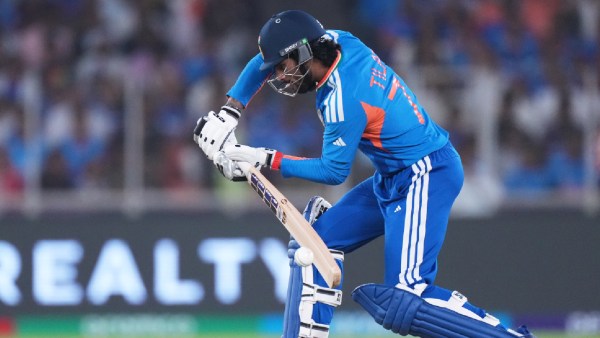 Tilak Varma in action. (FILE photo)
Given this game against spinners, that India have slotted him at No 5 itself is slightly surprising as they happen to be a team that is calculative in terms of the match-ups. And among all the positions that Tilak has batted, it is at No 5 where he has gone slow at 136.6. At No 3 and 4, he has been able to play the role of the enforcer and when pushed down to No 6 or 7, with a widespread range and comfortable against pacers, he has struck over 200, which is needed when you don the finisher’s role.
Among all his peers in the Indian team, Tilak is probably cut from a different cloth. As he admitted a couple of years back, the real struggle for him is to adjust his game to white-ball cricket. “Actually, since childhood I’m used to playing a lot of red-ball cricket. Because of IPL, many people know me as a white-ball player, but I know I’m a red-ball player, who is used to playing 500 deliveries. It is not new to me. For me, the pace of cricket is what I learned from IPL. Red ball cricket is my first priority. But I’ve to adapt to T20 cricket with practice and improving my mindset,” he told the BCCI.tv.
Two years on, he still remains a work in progress. Even in the IPL when he scored an unbeaten 101 against Gujarat Titans for MI, it all came down to him cutting loose in the end against the pacers. At the T20 World Cup, India’s plan was to slot him at No 3, one who would glue an attacking batting line-up. But with a tempting top three at hand, India moved Tilak down the order in place of Rinku Singh, a batsman who is more comfortable in the role of a finisher. Yet, the left-hander played vital knocks against the West Indies as well as against England.
 Tilak Verma of Mumbai Indians celebrates the after scoring a hundred during Match 30 of the TATA Indian Premier League 2026. (Photo by Surjeet Yadav / CREIMAS for IPLPhoto by Surjeet Yadav / CREIMAS for IPL)
In the first of those games, India’s plan to hold back Shivam Dube worked as Brook still ended up exposing two of his spinners to the left-hander, who didn’t need any second invitation to feast on. Given Dube’s failure as a finisher for CSK in the IPL and Tilak’s shortcomings against spinners, swapping their positions going forward is what India perhaps need when there is no Rinku.
Story continues below this ad
For a series where Hardik Pandya and Nitish Kumar Reddy weren’t available, the omission of Rinku itself raised eyebrows as it is a specialist role that no other batsman has managed to embrace successfully. Only Tilak managed to do it, and there was a reason too. With a strong game off the square and his ability to use the depth of the crease means, he was able to covert the lengths to his advantage. That sort of creativity has lacked in Tilak when it comes to batting in the middle-overs when the spinners operate with tight leg-side fields denying him the length to slog-sweep. For a batsman of his calibre, Tilak has left it too long without addressing it, but the time to level up, may have finally come now.