


Even from a distance the eyes can’t miss Blessing Muzarabani. In half-sleeve, bright green practice suits, he towers above his teammates. He is six foot nine inches tall; his shoulder-span befits his height and the cropped dreadlocks sit like a crown on his head. He is in a world unto his own, stretching his sinews, painstakingly measuring his run-up with a tape the mild breeze takes for a toss. The steps are leisurely, as though the force of gravity is pulling him down. The movements gradually gather momentum, before he begins his run-up. No wild energy seizes him, as he breaks into his strides. The release has no violent twists of his body or explosive leave; it’s just as though he is brisk-walking into the delivery.
But the ball magically explodes off the surface, not at knee-shaking pace but at an awkward height that discomfits batsmen. He was bowling in an empty nets, but you could visualise the ball’s path. Into the mid-riff of a right-hander, an imaginary batsman hopping to get on top of it, or miscuing the last-ditch pull. He is Zimbabwe’s pace-bowling talisman (11 wickets and an economy rate of 7), widely considered as the most lethal since the late Heath Streak.

He is not express quick, but moves the ball sharply into the right-hander with supreme precision and steep bounce. He need not be reminded that India’s batsmen tend to struggle against tall bowlers with whippy releases, capable of hitting the good and fuller lengths. Most expect him to hit the hard lengths more often, but he has mastered varying lengths that could torment India’s batsmen struggling for fluency. He has a friend in this Chepauk bouncy strip. And a guiding force in Courtney Walsh, the bowling consultant, who is almost entirely devoted to Blessing in training.
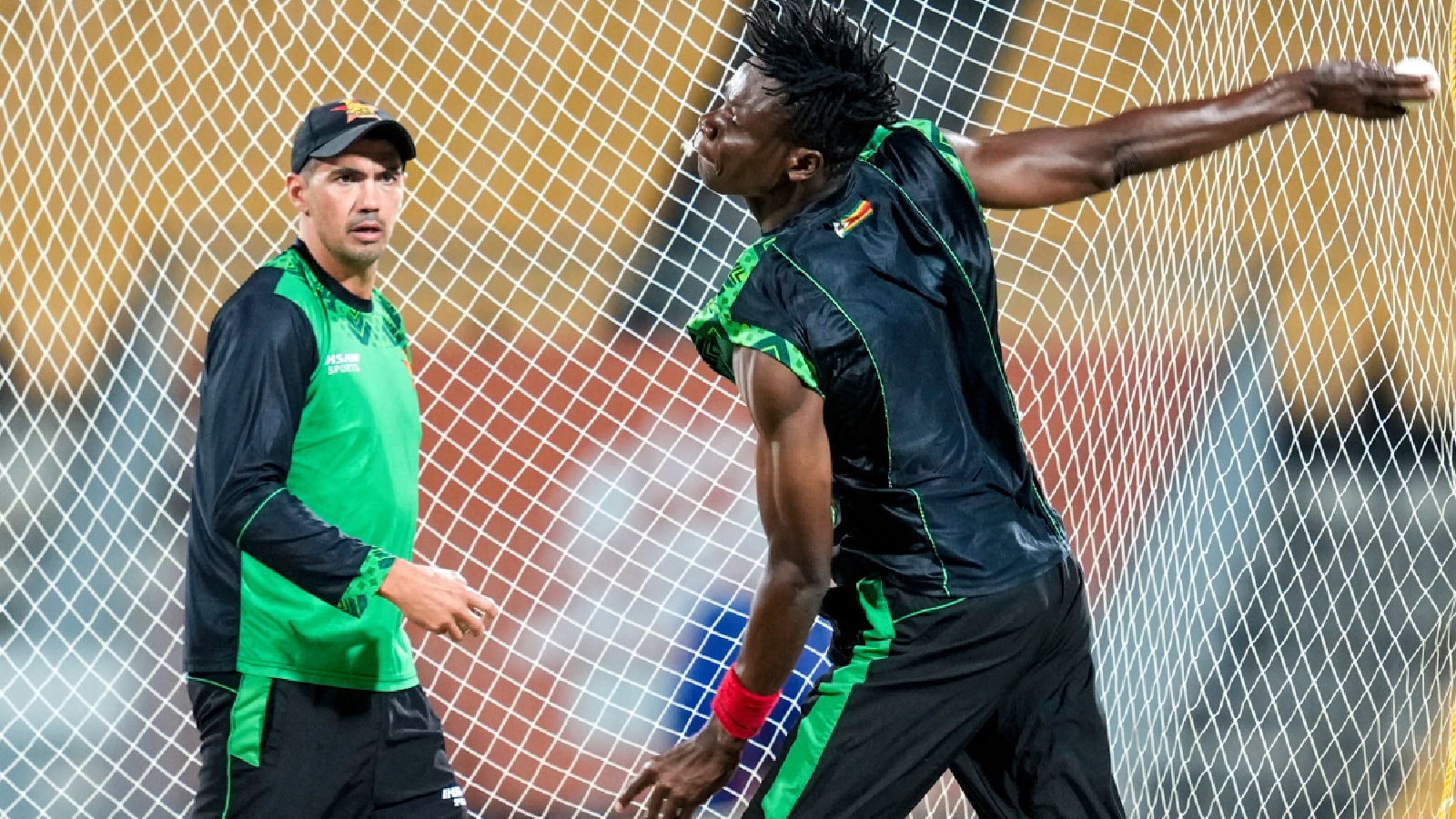 Zimbabwe’s Blessing Muzarabani, right, during a training session ahead of the ICC Men’s T20 World Cup 2026 cricket match between India and Zimbabwe, at MA Chidambaram Stadium, in Chennai, Wednesday, Feb. 25, 2026. (PTI Photo)
The release takes some getting used to. “His release does kind of come a little bit from beyond the perpendicular. So jagging the ball back into the righties and across the lefties with that steep bounce does pose quite a lot of a challenge for the batters,” his teammate Ryan Burl explains. A batsman, Burl says he is happy “knowing that he’s on my team and not on the opposition.” Some of India’s batsmen would agree that it is difficult to find boundaries. In India’s last tour to Zimbabwe, in 2024, he conceded only six runs an over in four games. He wouldn’t find India’s batsmen at their lowest ebb than before the Chennai must-win game.
In that series, though, Muzarabani had a largely inexperienced support cast barring the multi-utility spinner Sikandar Raza. Since then, the left-arm seamer Richard Ngarava and medium pacer Brad Evans have blossomed. Ngarava is slippery, seams the ball both ways and boasts of a deceitful off-cutter (that got rid off Brandon King in the West Indies game) and an accurate yorker, especially to the left-handed batsmen; Evans pounds the deck hard and rushes the batsmen. But for the West Indies aberration, they have shown the assortment of skills that have seen them bowl out two of their oppositions, including Australia, in five World Cup games. The reputation of hitters in their opponents don’t daunt them.
The spinners might not induce pre-match shivers. But Raza is an uncanny spinner that can bowl leg-breaks, off-spinners and can flick a carrom ball. He plays around with his angles and release points. Brian Bennett’s fast off-breaks are sparsely used, but with India’s storied off-spin woes, he could be handed an over or two. Tall and with a high release, he gets bounce, even though he has a tendency to bowl short. Graeme Cremer’s wrong’un could be an effective weapon against India’s left-hand heavy batting order. They might not possess a regular off-spinner, but the collectivism of their assorted skills could pose questions.
They might not open with an off-spinner, but have ample diversity. “We’ve obviously got a lot of options and that’s probably one of the advantages of the Zimbabwe lineup is we’ve got left arm seamer, right arm seamer, we’ve got a couple leg spinners, we’ve got an off spinner, we’ve got a left armer. So we do have quite a lot of depth and I think it will probably just come down to what are the match-ups depending on the batters that are out there at the time and obviously the combinations that we do look to go for,” Burl pointed out. He could chime in with leg-breaks too.
Story continues below this ad
They might concede a humble, unfashionable group vibe. No mystery spinners with magic hats, no tearaways, no one that is a franchise cricket rage. But the opponents would know they have men that could humble more established batsmen. They are blessed with Blessing too.


