


6 min readAhmedabadFeb 19, 2026 05:12 PM IST
A novelty tactic deployed by the visionary Martin Crowe in the 1992 ODI World Cup has found a revival in the 2026 T20 World Cup. Crowe, the New Zealand captain, opened the bowling with Dipak Patel, a journeyman batting all-rounder, recast into an off-spinner. The move shocked the favourites Australia, co-hosts and defending champions. Similarly, captains have used seemingly ordinary off-spinners to handcuff India’s power-packed top-order. It has worked tellingly, to such an extent that it has emerged the unforeseen tragic flaw of this wondrously knit batting unit.
None of Aryan Dutt, Salman Ali Agha and Gerhard Erasmus induce sleepless nights. Batsmen don’t hawkishly pore over their footage. None of them turn the ball precociously away from the left-hander, and on the contrary, spin or angle the ball into them; none possess befuddling variations or roll out arcane tricks from their sleeve. Bestowed with humbler virtues, they deal with subtle change of pace, angle and release points, at a spinner’s good length, or just shorter.

None are specialist bowlers, but bit-part ones. Those that the Indian batsmen of a previous generation would have scavenged. Virender Sehwag batted with the conviction that the off-spinners were to satisfy the six-lust of batsmen. He demolished the best of them, including Muttiah Muralitharan.
Suryakumar Yadav and his battery of power hitters have encountered hundreds of such colourless spinners in the domestic circuit. Yet those have hung the biggest question marks in their title defence.
The sluggish nature of the pitches has influenced the toils against spinners, believes India’s assistant coach Ryan Ten Doeschate. “I think these two venues (Colombo and Ahmedabad) in particular have bigger boundaries. It’s a slower wicket in Colombo, so it does exaggerate that. But it’s something we’re going to have to focus on. Like I said, with the amount of finger spin we’re going to get in the next three games, it is important that we dominate that phase,” he said.
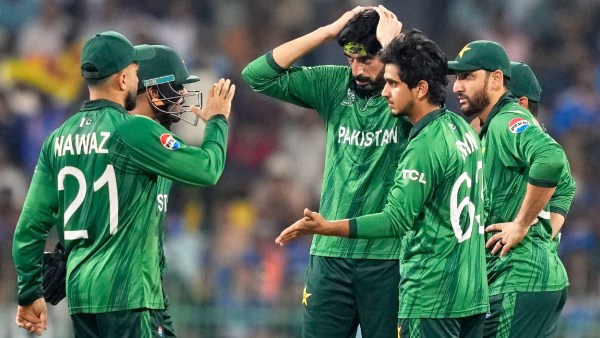 Pakistan’s Saim Ayub, third right, celebrates with teammates the wicket of India’s Tilak Varma during the T20 World Cup cricket match between India and Pakistan in Colombo, Sri Lanka, Sunday, Feb. 15, 2026. (AP Photo/Eranga Jayawardena)
In four games, they have faced 13 overs of semi-conventional off-spin, scored 86 runs and losing seven wickets. Of those, 36 runs have come from the three wayward overs of Namibia’s Colin Ackermann. Add the unconventional off-spin pair of Saim Ayub and Usman Tariq, India’s batsmen have managed only 6.4 runs an over against them, while losing a wicket for every twelve runs. That is, off-spinners have accounted for nearly one third of India’s wickets (11 of 31).
Story continues below this ad
The adversaries in the Super Eight would have duly observed. Most of them have off-spinners that fill the criterion. South Africa have Aiden Markram and Tristan Stubbs, Zimbabwe possess Sikander Raza and Brian Bennett; West Indies can avail the services of the tall and experienced Roston Chase. All would have already started training with the new ball in the nets to exploit this unprecedented vulnerability of India.
It would be almost a default ploy against Abhishek Sharma in the powerplay. Two of Abhishek’s ducks have come against the off-spinner in the first over. Agha’s ball skidded onto him, Dutt’s ball was back of length, quicker through the air and turning into him with the angle from wide off the crease. Ishan Kishan, in indestructible touch, too fell to the humble wiles of Dutt. Fortune smiled on Dutt this time, as the ball was heading down the leg-side, before it ricocheted off Kishan’s thigh and elbow into the stumps. But the ball bounced more than he had anticipated. Dutt is a tall man (six feet four inches), with a high release point and imparts revolutions on the ball. Agha is shorter but gets over-spun bounce.
Though Kishan has reeled out two storming half-centuries this campaign, an off-spinner has nailed him in three of his four innings (and USA didn’t have one). Even through the carnage of Pakistan, where he batted at nearly a 200 strike rate, he mustered only a modest 25 off 20 balls from Agha and Ayub, before the latter castled him. He faced three balls from Dutt, scored five runs and perished. Tilak Varma has perished just once to an offie, but could eke out only 26 runs off 31 balls.
In a conventional sense, the struggles were foreseeable against a southpaw-stacked top seven. Only Suryakumar and Hardik bat right-handed. But Suryakumar himself has strangely found the going tough, collecting 28 from 27 balls, striking only a four and six apiece and conceding nine dot balls. Hardik has faced only four balls, he got out twice and collected seven runs.
Story continues below this ad
A raft of local off-spinners could be summoned to the Motera nets in days leading up to the Super Eight fixture against South Africa. Washington Sundar, the lone specialist off-spinner in the squad, could get a longer bowling haul in the nets. Tactically, how India would deal with the off-spin blemish would define the Super Eights. Perhaps, India could shuffle their batting order. Suryakumar and Hardik could move a spot higher, or could recall Sanju Samson for Rinku Singh to improve the right-left equilibrium, lest it becomes a tragic flaw that could script a tragic ending for the defending champions. And how a left-field trick from a cricketing visionary is being revived in strangely similar circumstances.


