


When the World Cup began a month ago, France and Spain were widely tipped as the tournament favourites, with most prediction models rating them above even defending champions Argentina. By the time the two modern-day European rivals met in Dallas for a third successive summer in a major tournament, France had edged ahead in the bookmakers’ odds, not just to win the semifinal but also to lift the trophy. The reason was obvious. Kylian Mbappe, Ousmane Dembele, Michael Olise and Bradley Barcola had ripped through opponents with pace, movement and individual brilliance.
Yet Spain, who quietly went about their business after an opening draw against Cape Verde, made that terrifying French attack look remarkably ordinary.
It ended 2-0, exactly as the scoreboard suggests. But beneath that scoreline lay a tactical masterclass built on control, discipline and relentless pressure that suffocated France from the opening whistle.
France’s attack had thrived all tournament on one familiar pattern: win the ball, attack vertically, stretch the defence and release runners into space. Spain denied them every part of that sequence. Every time France recovered possession and looked to break, Spain’s aggressive counter-press closed the space before Les Bleus could even build momentum. Olise, Dembele and Barcola repeatedly received the ball in promising positions, only to find passing lanes closed and teammates tightly marked.
The biggest reason? Spain’s midfield.
Rodri, who endured a difficult club season while recovering from the serious knee injury he suffered in September 2024, looked every bit the Ballon d’Or winner again. Against France, he elevated his performance even further. Every French attack seemed to run into him. Whether breaking up play, intercepting passes or calmly recycling possession, Rodri dictated the rhythm of the contest. Alongside Fabian Ruiz and Dani Olmo, Spain completely controlled the centre of the pitch.
By contrast, France’s midfield pairing of Adrien Rabiot and Aurelien Tchouameni struggled throughout. They were constantly outnumbered, pressed from every angle and rarely able to progress the ball cleanly.
Olise, arguably the most creative player at this World Cup, endured his poorest outing of the tournament. Time and again, Rodri denied him the time and space needed to pick decisive passes. When the Bayern Munich winger drifted wide to test Marc Cucurella, Spain’s left-back was equally disciplined, leaving Olise without any meaningful influence.
Didier Deschamps searched desperately for solutions. He dropped Olise deeper in search of more control, but Rodri and Ruiz simply followed him. At half-time, Manu Kone replaced Rabiot to provide greater composure in midfield. Just before the hour mark, Desire Doue came on for Barcola, whose greatest weapon — running into space behind the defence — had been nullified by Spain’s compact back line. Later, Rayan Cherki replaced Olise. By then, Spain were already two goals ahead, and France were yet to register a shot on target.
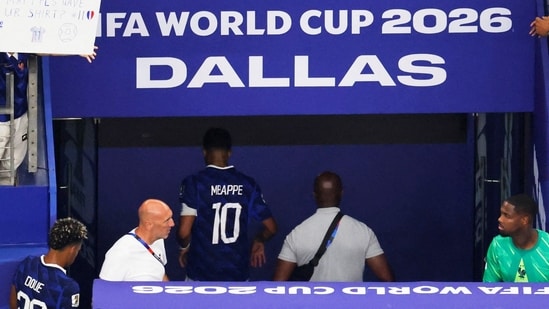
As Spain tightened their grip, Mbappe and Dembele became increasingly isolated. The Golden Boot leader repeatedly tried to create moments on his own, but was forced into chasing long balls or drifting into offside positions. Without service, even one of football’s deadliest forwards became a peripheral figure. By full-time, Mbappe had failed to register a single shot on target.
The numbers underlined Spain’s dominance. Porro, Rodri, Laporte, Cubarsi and Ruiz combined to win 25 of their 34 duels (74%) while making 44 defensive interventions. Mbappe won only two of his 11 duels and generated just 0.08 expected goals from three attempts. France managed only 10 shots despite recording 152 touches in the attacking third.
Spain’s defence deserves just as much credit. Pau Cubarsi and Aymeric Laporte remained composed throughout, winning key duels without ever abandoning their shape. Pedro Porro and Marc Cucurella balanced defensive discipline with attacking ambition superbly, ensuring France’s dangerous wingers never established any rhythm. Whenever Les Bleus looked ready to accelerate, Spain’s structure immediately swallowed the space.
The opening goal summed up Spain’s approach perfectly. Lamine Yamal’s aggressive run forced Lucas Digne into a rash challenge inside the penalty area, allowing Mikel Oyarzabal to convert from the spot.
France emerged after the interval with renewed urgency, briefly threatening to wrestle back momentum. But the spell lasted only a few minutes. Spain quickly regained control and, as France committed more bodies forward, the spaces between midfield and defence inevitably opened. Dani Olmo exploited them brilliantly. Constantly drifting into pockets between the lines, he pulled defenders out of position before releasing teammates. One such move ended with Pedro Porro doubling Spain’s lead and effectively ending the contest.
Deschamps’ tactical reshuffles never changed the pattern because France simply could not escape Spain’s press or establish sustained possession in dangerous areas. One decision will invite particular scrutiny. Desire Doue had long appeared the obvious starter on the left after his performances throughout the tournament, yet Deschamps opted for Barcola after a late rethink on matchday morning. Without space behind Spain’s defence, Barcola’s greatest strength was rendered almost useless, leaving him without a meaningful role in the game.
In the end, Spain did far more than eliminate France. They systematically dismantled every weapon that had carried Les Bleus to the semifinal, transforming the tournament’s most feared attack into frustrated spectators for much of the biggest match of their World Cup campaign.