


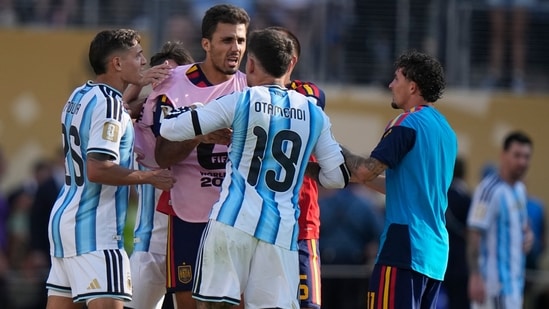
Argentina’s unsuccessful World Cup title defence did not end when Ferran Torres scored Spain’s winning goal in the 106th minute of the final. The defeat was followed by an even more damaging collapse in discipline, with confrontations between the two teams escalating into a brawl during Spain’s celebrations.
Spain won the final 1-0 after extra time to secure their second World Cup title. Argentina had been reduced to 10 men in the 93rd minute when Enzo Fernandez received his second yellow card for a late challenge on Pau Cubarsi.
Lionel Scaloni’s side survived the remainder of normal time but were eventually broken down by Torres. Tempers then boiled over after the final whistle as Spanish substitutes and staff entered the pitch to celebrate.
FIFA has now opened a formal investigation into the conduct of Argentina’s players and officials. Its Disciplinary Committee has examined the initial match reports and appointed a Disciplinary and Ethics Prosecutor to investigate potential breaches of the FIFA Disciplinary Code.
No Argentine player or staff member has officially been charged yet. FIFA has also not announced when the investigation will be completed or when possible sanctions could be revealed.
Several members of the Argentina camp are under scrutiny, but FIFA must first study the available evidence before deciding whether to begin formal disciplinary proceedings.
What FIFA is investigating after the World Cup final brawl
Leandro Paredes and Nahuel Molina appear to face the most serious questions over their alleged involvement in the confrontation.
Footage from the aftermath appeared to show Molina swinging at Spain captain Rodri as the Spanish substitutes ran onto the pitch to celebrate. Rodri immediately confronted the Argentina defender, with players from both teams gathering around them.
Paredes then became involved in separate confrontations with Eric Garcia and Gavi.
The Argentine midfielder appeared to make forceful contact around Garcia’s neck before turning towards Gavi. The Barcelona midfielder was subsequently wrestled or pushed to the ground as the confrontation widened.
Thiago Almada was also caught in the altercation involving Gavi, although his precise role remains less clear. Being present inside the melee would not automatically amount to a disciplinary offence. FIFA must determine whether each individual was attacking, restraining another player, attempting to separate the participants or merely caught in the disorder.
Lisandro Martinez and Nicolas Otamendi were also seen in confrontations during the aftermath, but there is currently less clarity over whether their actions will become part of formal disciplinary proceedings.
Argentina assistant coach Roberto Ayala is another figure understood to be under examination after footage appeared to show him striking Dani Olmo during the disorder. Ayala’s position as a member of Scaloni’s coaching staff would not protect him from punishment. FIFA’s misconduct provisions apply to team officials as well as players.
Initial reports suggested that Paredes had been shown a red card after the final whistle. However, no dismissal was officially recorded against him. That means Paredes does not currently carry an automatic one-match suspension arising from the brawl. Any punishment would have to be imposed retrospectively after FIFA completes its investigation.
Enzo Fernandez’s situation is different. His dismissal occurred during the match and automatically carries a suspension from Argentina’s next official international fixture. That sanction is separate from the post-match investigation.
Unless FIFA discovers evidence that Enzo was involved in additional misconduct after leaving the pitch, he is unlikely to be one of the central figures in the brawl proceedings.
How FIFA will build its case
FIFA can examine the referee’s report, supplementary reports submitted by match and field delegates, television footage, photographs and recordings from additional stadium cameras.
The appointed prosecutor can also request written explanations from the Argentine Football Association, the players and staff members involved. Individuals can be questioned, while additional documents and witness accounts may also be sought.
FIFA does not need to prove guilt beyond a reasonable doubt, as would be required in a criminal case. Its disciplinary bodies instead decide whether they are comfortably satisfied that an offence occurred after considering the available evidence.
Reports submitted by the referee and match officials are generally presumed to be accurate unless convincing contrary evidence is presented. FIFA can also punish serious misconduct retrospectively when the referee did not see the incident or was unable to take action during the match.
That is particularly relevant to the alleged actions involving Molina, Paredes and Ayala. None would be protected merely because the referee failed to issue an immediate red card.
What punishments could Paredes and Molina receive?
The FIFA Disciplinary Code establishes different minimum punishments depending on how an incident is classified. Unsporting behaviour towards an opponent or another person carries a minimum one-match suspension. Serious foul play can result in at least two matches, while violent conduct carries a minimum ban of three matches.
Assault also carries a minimum suspension of three matches or an appropriate period of suspension. The code identifies punching, kicking, elbowing, biting, spitting at or hitting another person as potential forms of assault.
If FIFA concludes that Molina deliberately struck Rodri, the incident could fall directly under assault or violent conduct. That would expose him to a minimum three-match suspension. Even if FIFA decides that Molina’s apparent swing missed or made only limited contact, he would not necessarily escape punishment. Attempted infringements can also be sanctioned.
Paredes could face an even more serious punishment if FIFA treats his confrontations with Garcia and Gavi as separate aggressive acts. The three-match suspension for violent conduct is only a minimum, not a maximum. FIFA can increase the punishment after considering the seriousness of the offence, the number of incidents, whether the player initiated or escalated the confrontation and whether there were any aggravating or mitigating circumstances.
A suspension of four or five Argentina matches would therefore be possible if repeated violent conduct is established. FIFA could also examine whether any player acted as an instigator or accomplice. Players who encouraged, intensified or actively participated in the confrontation can be punished even if they did not land a clear punch or kick.
What punishment could Ayala face?
Ayala could face a similar disciplinary range if the alleged strike on Olmo is proven.
FIFA can suspend an official for a specified number of matches or for a defined period. During that suspension, Ayala could be prohibited from entering the dressing room, tunnel or technical area.
He could also be prevented from communicating with Argentina’s players or coaching staff before and during matches. Any punishment would apply to Argentina fixtures rather than his wider professional activity unless FIFA imposes the much more serious sanction of a ban from all football-related activity. Such a sweeping punishment is possible under FIFA’s regulations, but would be highly unlikely on the presently known evidence.
Could the Argentine Football Association also be punished?
The investigation is not limited to individuals. The Argentine Football Association can be held responsible for the conduct of its players and officials during an international match, even if it did not instruct or encourage the misconduct.
It can also be held jointly responsible for fines imposed on Argentine players or members of the coaching staff. The most realistic association-level sanction would be a financial penalty. FIFA could also issue a warning, reprimand or other disciplinary measure if it determines that Argentina’s collective conduct amounted to team misconduct.
In more serious cases, FIFA has the authority to order partial stadium closures for future international matches. However, such a punishment would depend on the number of individuals charged, the seriousness of the incidents and the overall assessment of Argentina’s responsibility.
There is no realistic possibility of Spain’s victory being overturned, the final being replayed, or Argentina being stripped of their runners-up position. The confrontation did not affect the competitive outcome of the match, which had already been decided. The genuine threat to Argentina lies in individual suspensions and financial sanctions.
Paredes and Molina face potential bans of at least three matches if violent conduct or assault is proven. Longer suspensions remain possible if FIFA finds repeated aggression or other aggravating factors. Ayala could be removed from Argentina’s technical area for several fixtures, while the Argentine Football Association may receive a substantial fine and additional disciplinary measures. Until FIFA releases its formal charges, however, the case remains an investigation rather than a verdict.