


For most of his sparkling career, Novak Djokovic had the wins but not quite the love he thought he deserved. Now he has the love, but the wins have grown elusive. Is Djokovic at peace with life’s either-or reality? Has he come to accept that longing never dies, it merely takes new forms? And why does the GOAT, who averaged two Grand Slams a year in his prime and is now without a Major for close to three years, stick around?

The answer can’t be found on the court. It is hidden in the smiles on the faces of his two little children when they watch him win, and in the collective roar of an entire stadium when they cheer him. Trophies he has had many, but these days Djokovic is collecting something he missed for years.
Painted as the party-popping villain by countless Federer and Nadal fans through the Big Two era, he is now the clear crowd favourite at Slams. Djokovic may or may not get his 25th Slam, but he is gathering new memories, priceless enough to outweigh the bitterness of once feeling unloved.
One such moment came at the end of the five-hour, five-set epic in this Wimbledon’s quarter-final. Djokovic mentioned that he had asked his children to go to sleep, since it was well past their normal bedtime, but they hadn’t. In his heart of hearts, he would have wanted them to stay.
Back in the day, whenever the Serb was asked about retirement, he would mention his kids: he wanted them to grow up and witness what Dad was good at. Now it was happening. He would later say, “I’m glad they stayed because it was honestly one of the best matches I was part of on this court in my career.”
Some time back, his son Stefan was asked to write an essay on ‘My Hero’ at school. He picked his father instantly. A few years later, he was courtside at Wimbledon 2023, looking anxious, as the young Spaniard Carlos Alcaraz drew close to beating his father. Stefan looked tense; he couldn’t bear to see his hero lose. He didn’t have to.
ALSO READ | Vijay Amritraj: The tennis champion who carried India’s identity to the world
After the match, Djokovic teared up when he saw Stefan in the stands. The child looked confused, mouth agape, a few front teeth missing, too young to fathom the occasion’s weight for his father, or why grown-ups cried even when they were happy.
Something changed at Centre Court that day. The so-far partisan crowd flipped.
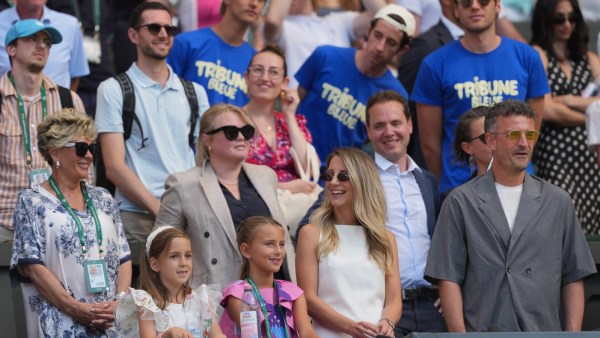 Djokovic’s family react to his win over Arthur Rinderknech of France in their third round men’s singles match at Wimbledon 2026. (AP)
Wimbledon had booed Djokovic when he played Federer, clapped at his double faults, and celebrated his errors. They weren’t ready to see their adopted royalty, the grass-court king, dethroned, least of all by an unfancied Serb rocking the boat. Djokovic’s tears, the innocence on Stefan’s face, that day many stiff English upper lips quivered. Against Sinner, the Centre court regulars chanted ‘Novak, Novak’ in the third and final set even when the world knew a comeback was out of question.
For most of this fortnight, the Djokovic family has charmed the crowds. In the early rounds, Stefan sat in the box with a boy his own age, cousin or friend unclear. Every time his father hit a winner, Stefan looked at the boy beside him with a smug smile, half the audience himself.
ALSO READ | Why a ‘self-critical’ Novak Djokovic keeps chasing greatness at 39
Tara, two years younger than Stefan, isn’t into tennis. She isn’t seen on the training courts. She loves ballet and gymnastics and has her own way of having fun with her father. In one on-court interview, Djokovic revealed that his daughter had been teaching him the Pompa, loosely “pump it up” in English. He said he is yet to master it, since Tara hadn’t given her approval. He would ask Tara to demonstrate and the cameras would find the little girl with blonde pigtails in the stands. The crowd would let out a collective “awwww,” the way they once did for the Federer twins.
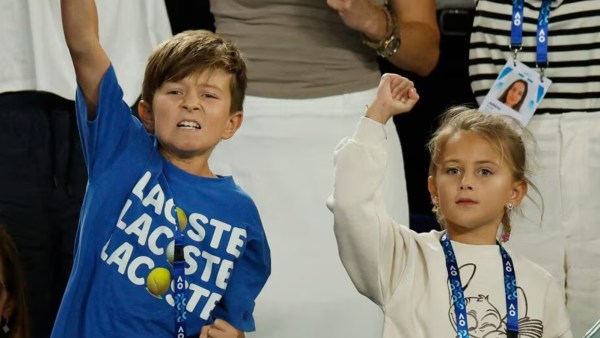 Novak Djokovic’s children, Steffan and Tara. (Credit: Reuters)
It isn’t that Djokovic was never loved. He was the crowd’s darling in his Djoker years, mimicking other players, fooling around on court, the amusing underdog who threatened no one’s place in history. But as he began beating Federer and Nadal, threatening their legacies, the affection curdled. He didn’t just have critics but toxic trolls and vicious haters.
That history still surfaces when he least expects it. After equalling Federer’s Wimbledon win record in the third round this year, he was told the number: 105, level with the Swiss champ. He looked almost bored by the question, before breaking into the line that drew laughter from Centre Court: “I propose a match-up between me and Roger for 106. Whoever wins gets it. Let’s just stop it here and let’s call Roger to come.”
He quickly switched to Tara’s dance training again and spoke at length about it. The Centre Court swooned once more.


