


Two miles from the Azteca Stadium, in Coyoacan’s Cafe Cruco, Jose Alvarez, the cafe owner, throws in a trivia: “Do you know what is in Azteca’s tummy?” Then, he informs with a proud smile: “It’s water, a large spring that almost touches the other world.” But, with a raised eyebrow, he adds: “When there is a match, we face water shortage, because the stadium has a thousand restrooms!”
He is not far wrong about the dimensions. The Azteca sits like a giant concrete sombrero, the traditional Mexican hat, in the Saint Ursula Coapa neighbourhood, over parts of a volcano that gushed its last fumes in the fourth century.

The narrow roads with murals of Mexican revolutionary Emiliano Zapata with his bristling moustache are cordoned off, mainly to ease traffic for players, and partly to keep off the teachers demanding a 100 per cent pay rise and truck drivers protesting kidnappings on the highways.
None of these tensions has spilled onto the arena, a canyon, a planet unto itself, the most sacred of footballing venues. The Guardia Nacional’s trucks scream by, the cadets toting guns in stiff grey fatigues, ensuring calm the day before the opening game.
The locals call it simply Azteca or Coloso, trimming Colossus of Santa Ursula. A few bends away is the church of Santa Ursula, the locale’s patron saint. “We live under the gaze of Santa and Azteca. Santa has blessed Azteca. That is why so much history has happened here,” says Alvarez. He addresses the arena as she. “She has a life of her own.” A throbbing soul inside bricks and cement.
Under that gaze, football’s gods have roamed freely. Pele and Diego Maradona have both hoisted World Cups here, now re-christened Estadio Banorte after a Mexican banking group, although nobody cares or bothers, and they still call it Azteca.
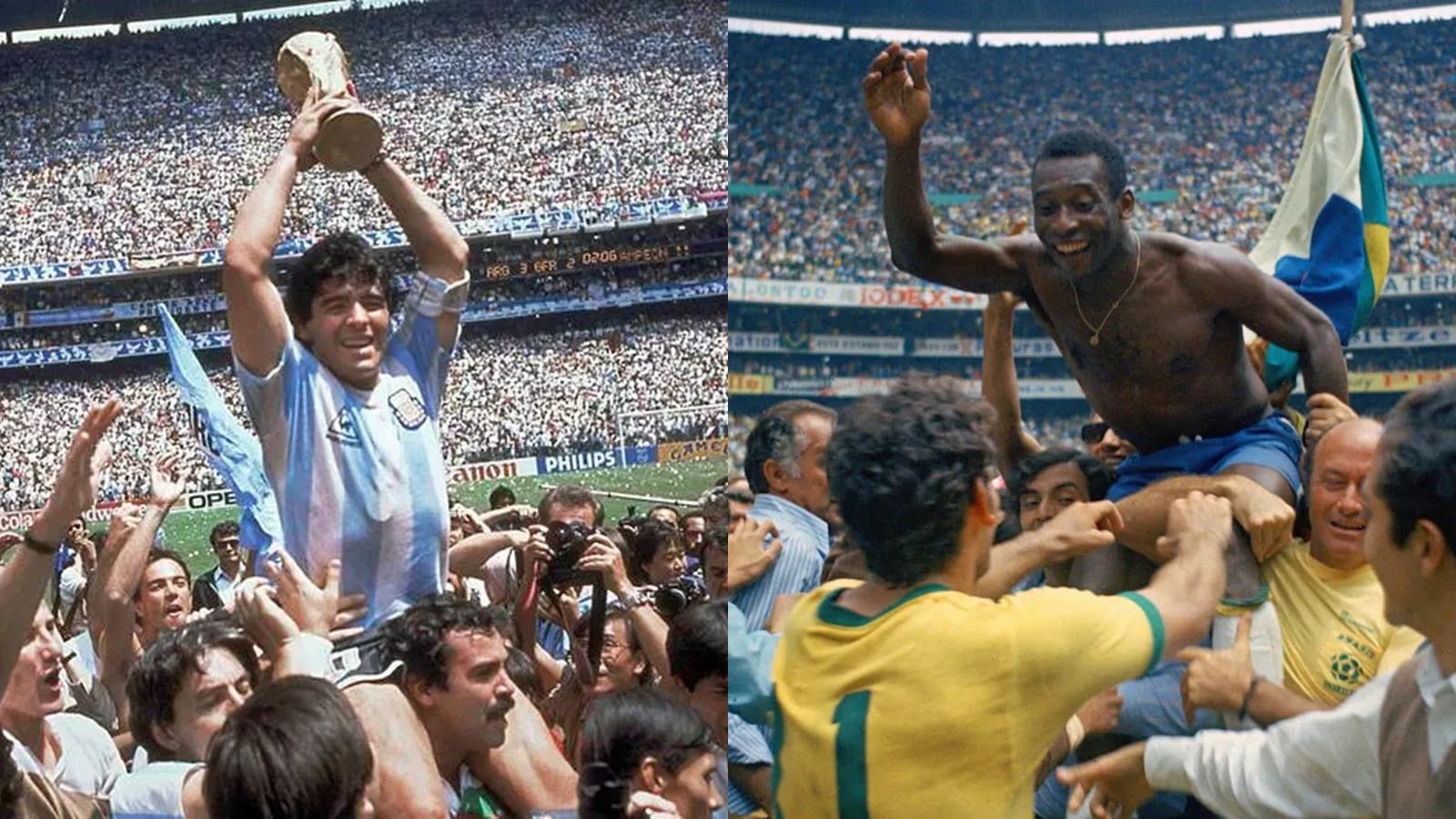 Both Pele and Maradona have lifted the World Cup at the Azteca. (AP File)
Pele lifted the trophy here in 1970 and scored in the final, an imperious header that opened the scoring against Italy. The room he stayed in during that tournament, at the Inter-American Conference on Social Security building nearby, is preserved.
Story continues below this ad
Maradona’s Hand of God goal is etched in a bronze relief in the arena’s museum. During his stint managing Mexican club Dorados in Culiacan, Maradona visited and, according to the newspaper Reforma, had a hearty laugh at the sight of it.
There is a less famous statue too: of Ignacio ‘Nachito’ Villanueva, the most loyal fan of Azteca, a supporter who did not miss nearly three decades of Club America’s home games. The club calls Azteca home.
The museum volunteers are exhausted. “We are putting in extra shifts because the tourists have been rushing,” says Amanda Lopez. “I wonder how the stadium will be during a match. 100,000 turning up!”
Its official maximum capacity is 87,500.
“Before renovation it was around 100,500, but in club games before the security got strict, we used to pack in 150,000,” says Javier, another volunteer. “It’s an experience we can’t put in words.”
Story continues below this ad
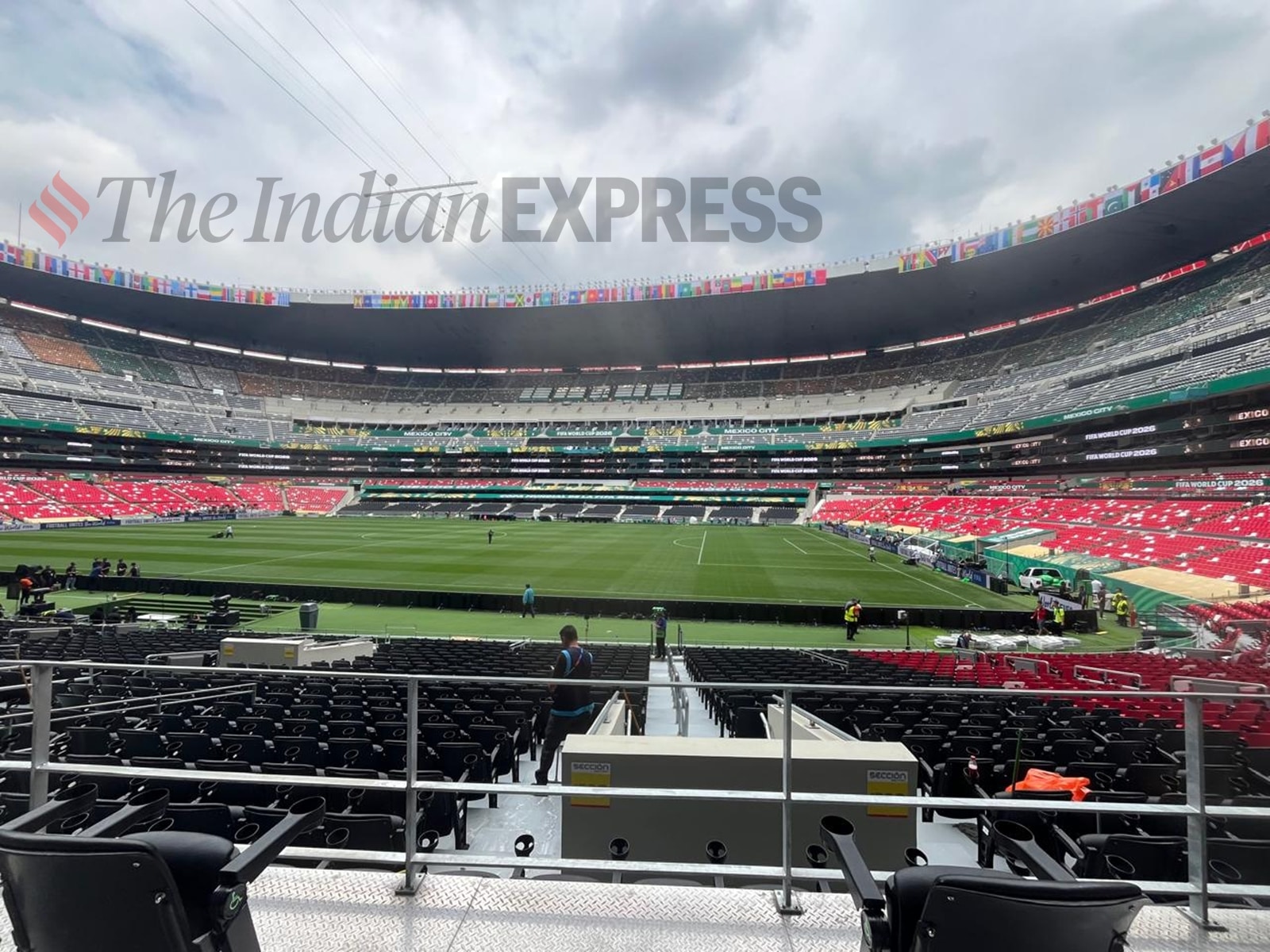 The Azteca’s official maximum capacity is 87,500. (Express Photo by Sandip G)
Even Pele felt the same. “There’s just something very special about the Azteca. You need to be inside it, to feel it, to understand. It’s unique.”
The vibe has to be experienced to fathom, but you can feel the thinning air, as the city is 2,200 metres above sea level.
Away teams historically gasp for breath. The architecture intensifies the ambience: steeply banked seats, difficult sight-lines, the distance of about 20 yards from the sideline to the team benches. According to a study, since 1986, Mexico’s World Cup matches at the Azteca have averaged crowd noise above 118 decibels. The noise can be so raucous that it caused an artificial seismic tremor when Mexico beat Germany at the 2018 World Cup in Russia.
Tickets for Thursday’s opener ranged from $3,000 to $5,000; those who could not buy one would huddle at the Angel of Independence monument in downtown Mexico City.
Story continues below this ad
Sometimes, the old-timers say, the atmospheric pressure suddenly drops. They attribute it to Quetzalcoatl, the invisible feathered serpent god. Myths and myth-making are irresistible in Mexico.
“Even when the arena is half empty, it buzzes as though a giant swarm of bees is marching,” says Javier. “There is a sound for silence too here.”
Former Australian international Craig Foster described it precisely: “Even when it’s relatively quiet, it still buzzes because there are so many people in there. It gets louder when their opponents start to fade. You can’t get close, you can’t get the ball off them, and it makes it so much worse. You start to implode.”
Mexico’s coach Javier Aguirre has urged the crowd to roar and fuel his team toward something historic. El Tri — the name given by locals to the national side — have won 68 of their 92 international games at this ground, losing only seven.
Story continues below this ad
Somewhere far below all of it, under the concrete and the volcanic rock, the spring Alvarez described is still there, almost touching the other world. Thursday night, 87,500 people will stand above it.