


New Delhi: Nozomi Okuhara may be in the twilight of her career, but even at this stage, picking her slices and drops requires special skill. Ishika Jaiswal not only sent everything back to Okuhara but also displayed the kind of stubbornness that the 2017 Japanese world champion is known for.
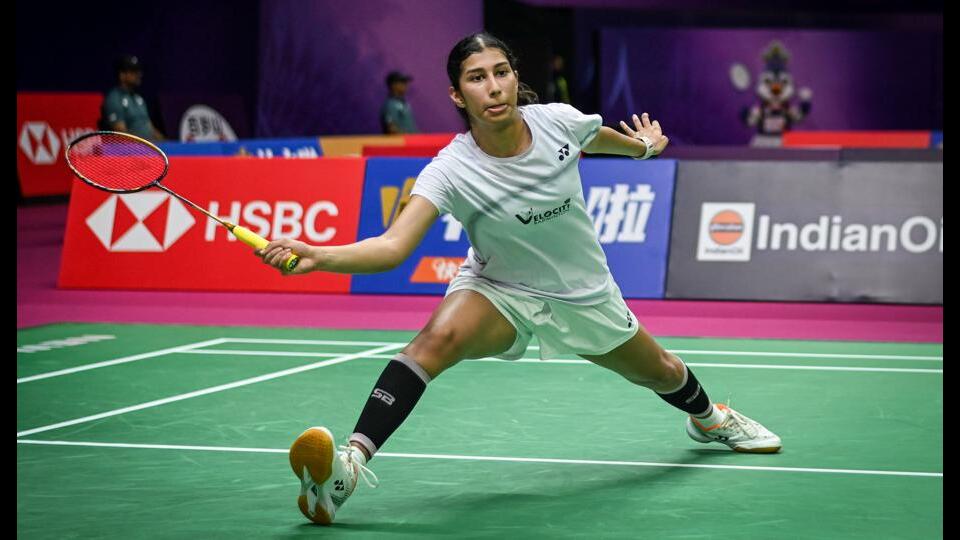
Okuhara was relieved to have come through a tough, close-to-an-hour-long round of 16 match at the BWF World Championships here.
Ishika was born in Alwar, Jaipur, but moved to the US early because of her father’s job. She has been representing the United States. Badminton isn’t very popular in the US and perhaps the only big name from the country that comes to mind is Beiwen Zhang, the Chinese player who has made the US her home.
With her relatives still based in India, Ishika uses the opportunity to travel and spar with Indian players whenever she comes here to play in tournaments.
“It’s been a difficult journey because we don’t have as many resources for a badminton player in the US as they do here, but we also get the advantage of figuring things out on our own, so it’s been hard but challenging,” Ishika told HT.
She doesn’t have sponsors to support her and often travels to tournaments on her own. “I just ask any coach who is available at the time of my matches to sit behind me. It’s difficult, but that’s the way it is.”
The 23-year-old was competing in her second World Championships and was proud of her feisty display against Okuhara, especially the way she fought back after losing the first game. Okuhara, who won 21-11, 13-21, 21-12, called her a “fighter.”
“Definitely, it is the best I have played at this level because I don’t think we get that many opportunities to play against top players,” said Ishika.
Ishika is ranked 61st in the world, but her game showed that, at least on this day, she belonged in the top rung. Having lost the first game, she fought back with patience, showing good defence and deceptive craft. It’s not for nothing that she considers Ratchanok Intanon her inspiration.
“I have always been a runner, rally and consistency have always been kind of part of my game. I used to be an attacking player, but when I realised my smashes can’t kill, I developed my overall game. I was inspired by Saina Nehwal, when I started to play, but I really like Ratchanok and the skill she has.”
She was happy to meet her role model Ratchanok in an earlier round here, with the Thai retiring midway due to an injury.
Ishika picked up a racquet when she was 10 and based in California. She trained under former Indian doubles player Shlok Ramchandran. Her father was a cricket fan, but her love was badminton.
She now trains in Texas, where her father has started a badminton club to help his two daughters and other shuttlers, most of whom are of Indian origin. Her sister Mihika recently won the U-15 girls’ singles title.
“I train at our own academy — Velocity Badminton Club in Texas, under coach Nagendra.” Ishika says the number of players of Indian origin picking up the racquet sport has increased. Before that, it was more Chinese-origin children playing badminton.
“The junior circuit is not very competitive. Several junior players are seeing me perform well at the world level and want to be successful. There are a lot of Indians in your academy and a lot of new kids are of Indian origin. Before, you would see a lot of Chinese-origin kids in the US.”
Stints in India, including sparring at the academy in Bengaluru, have made her tougher.
“There’s so much to learn sparring here because you have a lot of good youngsters.”
“Then whenever I get an opportunity, I train with Tanvi, Isha, Ashmita. We are friends. I kind of belong to the same group. All my family is here.”
“My goal is to qualify for the Los Angeles 2028 Olympics and I really want to establish myself in the top bracket in women’s singles,” says Ishika.