


New Delhi: Long queues for buses, more than two-hour travel time to the venue, cramped hotel rooms and cold food—it has not been a pleasant experience for the 30-member shooting team, which is among India’s top medal contenders. Since touching down at Nagoya airport, India’s shooting contingent had a harrowing time getting their accommodation and transport sorted.
The ordeal started after the shooters, coaches and support staff members landed at Nagoya airport late Wednesday night. They landed at 9pm and though the security check and weapon clearances happened rather quickly, after that they had to wait for two-and-a-half hours for the bus to arrive.
In fact, they were surprised to find that there were no volunteers and the dedicated desk to facilitate transport was empty, according to Indian shooting team members. Moreover, no buses were available for the shooters, who reached Nagoya via Hong Kong after a seven-hour halt.
“We had to wait for two-and-half hours to get a bus. It took us a lot of time to find someone to guide us with the transport. Everyone had already left. The security guard was there. We asked him how much time it would take. He went running inside and told us that we are arranging taxis for you because we are not able to communicate with the bus drivers,” a member of the shooting team told HT.
“We told him that we are 35 people, have a lot of luggage and it will not be possible to travel by taxis. He was a little surprised and it seemed there was no information of the contingent size.”
Upon arrival at their designated hotel (Grand Tiara), more surprises awaited. The team was told that they were booked in another hotel. By then, the coaches were furious because the Indian shooting team had confirmation to stay at the particular hotel, which is the biggest in the area and has a gym and other facilities.
Eventually, only seven rooms were given in the main hotel, and 33 rooms in a nearby hotel (Toyoko Inn), where the rooms are quite small. They finally checked in at around 4am (seven hours after arriving). The shooters and coaches moved to the new hotel because the bigger rooms in the main hotel were given to support staff and physios who needed space for their tables etc. The coaches insisted the entire team stay together, so everyone moved to the smaller hotel.
“The rooms are very small—so small that you cannot open your luggage. Fortunately, many received single rooms, so it is manageable due to single occupancy.”
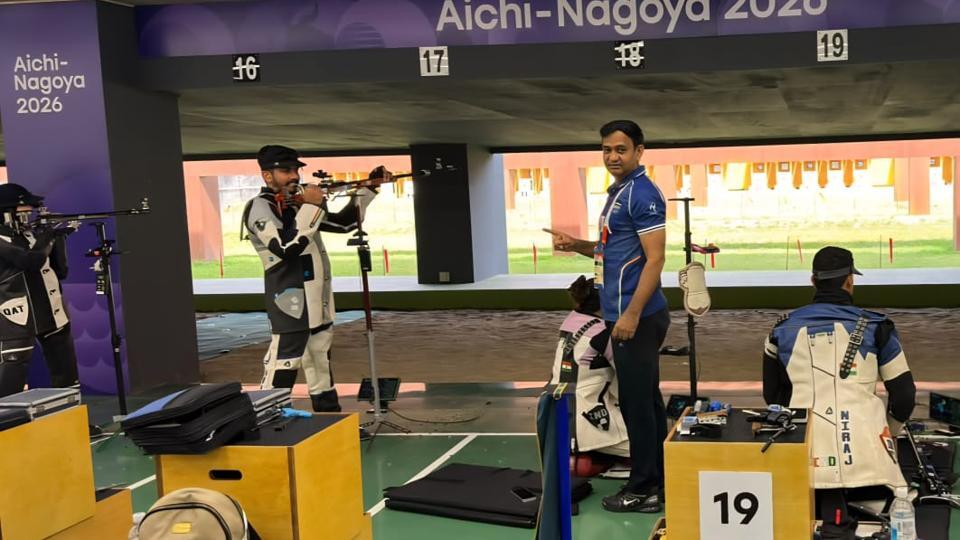
Going to the Aichi Shooting Range for training the next morning proved to be a big challenge due to a long queue for buses. The range itself is two and a half hours away.
“There was a big line for the bus. Many of our colleagues were not able to board the bus because the capacity of the bus was 50 and the people were more than 100.”
Some shooters had to wait for another hour to take the bus. “It took us two and a half hours to reach the range, which is a very long commute. It was very challenging and boring. We reached the range, finished our training and the food available was cold, packed lunches.”
Getting back to the hotel was another challenge, with another one-and-a-half-hour wait for transport, according to the shooters. Some had to wait for nearly three hours.
“There is a shortage of buses and frequency is also an issue. The range is so isolated that you cannot get taxis or cabs.”
The contingent contacted the Indian Olympic Association and arranged for some cars to ferry the shooters and support staff. Transport was smoother on Friday, but the travel time to the range remains an issue.
A third member of the contingent said that they expected the IOA to sort out issues at the airport and hotel accommodation but there was nobody to facilitate.
The arrangements at the Aichi-Nagoya Games have drawn criticism due to the accommodation facilities and logistical challenges athletes are facing. With less than 24 hours until the Games open, headlines focus on the shoddy organising, with organisers scrambling to provide rooms to contingents.
The container-style rooms and a docked cruise ship, doubling up as accommodation, have been heavily criticised by several teams. According to the information, the Games are accommodating over 17,000 athletes and support staff, plus 5,000 technical officials.
India’s chef de mission Sahdev Yadav informed on Friday that the IOA booked extra rooms because organisers had removed around 30 to 35 Indian athletes from the accommodation list.
“The Organising Committee informed us that more players than expected had come (from India). But as far as India is concerned, that’s not the case. We stuck to the number of players they had invoiced. But they removed some names, so we booked hotels for them. We faced difficulty with regard to 30-35 athletes,” Yadav was quoted as saying by PTI on the sidelines of the flag-hoisting function.
“Our team quickly swung into action to secure accommodation for the athletes as quickly as possible,” Yadav said.
“Yes, there is mismanagement, but it’s a big event and it can happen. But we have to look beyond that. We have to take care of our athletes and solve their problems and get them good accommodation so that they are in the right frame, both physically and mentally, to win medals and be relaxed.”