


With just days to go for the men’s T20 World Cup, the Pakistan government on Sunday directed its team not to play against India in the group-stage fixture in Colombo on February 15, even as it cleared its participation in the tournament.
“The government of Pakistan grants approval to the Pakistan cricket team to participate in the ICC World T20 2026. However, the Pakistan cricket team shall not take the field in the match scheduled on 15th February against India,” the Pakistan government said in a statement.
This came just hours before the team was set to fly to Sri Lanka, where they will be based for the duration of the tournament which begins on February 7.
While the Pakistan Cricket Board (PCB) is yet to inform the International Cricket Council (ICC) about the decision, the world body, in a statement issued later in the evening, warned that “selective participation undermines the spirit and sanctity of the competitions”, and could have “long-term implications”.
“While the ICC awaits official communication from the Pakistan Cricket Board (PCB), this position of selective participation is difficult to reconcile with the fundamental premise of a global sporting event where all qualified teams are expected to compete on equal terms,” it said.
“The ICC hopes that the PCB will consider the significant and long-term implications for cricket in its own country as this is likely to impact the global cricket ecosystem, which it is itself a member and beneficiary of,” it said. “While the ICC respects the roles of governments in matters of national policy, this decision is not in the interest of the global game or the welfare of fans worldwide, including millions in Pakistan… The ICC’s priority remains the successful delivery of the ICC Men’s T20 World Cup which should also be the responsibility of all its members including the PCB… It also expects the PCB to explore a mutually acceptable resolution, which protects the interests of all stakeholders,” it said.
ALSO READ | Pakistan government tells its team to boycott India T20 World Cup match
Story continues below this ad
As reported by The Indian Express earlier, when the PCB threatened a full boycott of the T20 World Cup — in solidarity with Bangladesh, which was replaced by Scotland after they (Bangladesh) refused to travel to India citing security concerns — sources in the ICC had said there could be severe sanctions on Pakistan, including the suspension of bilateral series and a ban on international players featuring in the Pakistan Super League.
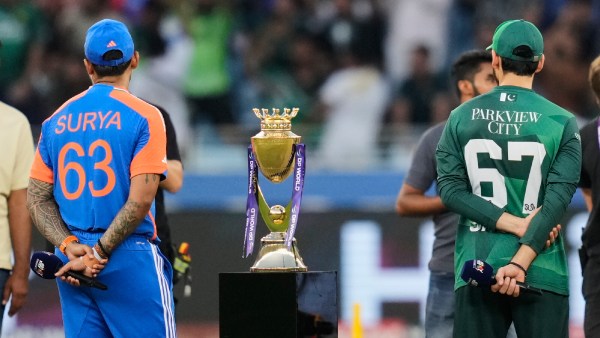 India’s captain Suryakumar Yadav, left, and Pakistan’s captain Salman Agha stand for the coin toss of the Asia Cup cricket final between India and Pakistan at Dubai International Cricket Stadium, United Arab Emirates, Sunday, Sept. 28, 2025. (AP Photo/Altaf Qadri)
While Sunday’s statement specified the February 15 match, sources in Lahore said Pakistan not taking the field in a knockout fixture against India later in the tournament wasn’t part of their plan. “It is not our decision. We have to do what our government and the chairman (PCB) decide,” Pakistan captain Salman Ali Agha said in Lahore.
The Indian cricket board said it has already made arrangements for the match in Colombo. “Our hotel has been booked and ICC has already booked flight tickets for the Indian team. The BCCI hasn’t received any mail from the ICC informing about Pakistan’s decision. We checked with ICC and they too have not received any official mail on this,” a BCCI official told The Indian Express.
Pakistan’s decision will have a serious impact, both on and off the field. The broadcaster, which pays Rs 138.7 crore per match, is staring at a huge loss as India vs Pakistan is the most-anticipated match, drawing peak viewership and generating the most revenue through advertisements.
Story continues below this ad
If Pakistan sticks to the decision, they will have to win all their remaining three group fixtures against the Netherlands, USA and Namibia to avoid an early elimination, as they stand to lose two points and their net run rate will also take a hit.
In the past, there have been instances in ICC events when teams refused to play, citing government decisions. In 1996, Australia and West Indies didn’t play in Sri Lanka citing security reasons, and as a result the island nation was awarded points which helped their passage to the knockouts.
During the 2003 World Cup, England boycotted their match against Zimbabwe due to bilateral tensions. In the same tournament, New Zealand didn’t travel to Nairobi for their group match against Kenya after the ICC refused to change the venue despite security concerns. In the 2009 World T20, Zimbabwe declined to travel to England due to differences with the government.
In all these cases, none of the member boards faced any sanctions or revenue loss as they acted on the basis of government orders.


