


5 min readMumbaiAug 3, 2026 08:10 AM IST
India travelled to Glasgow with expectations suitably calibrated.

These were, after all, the Commonwealth Games in a scaled-down format. The programme had been trimmed, leaving India with fewer medal prospects. Six of the 12 sports in which India won a medal at the 2022 edition, accounting for 30 of its 61 medals, had been axed. For many athletes, the competition was never meant to be the peak of the season. With the Asian Games looming next month, Glasgow was seen more as a checkpoint than a destination.
Yet, by the time the curtains came down on Sunday, India’s campaign had become one of its most memorable in recent CWG history — not merely because of the medal tally, with India surpassing expectations to finish fourth overall with 39 medals, including 13 gold, 17 silver and nine bronze, but because of the number of barriers broken.
It was a Games of firsts.
ALSO READ | Indian boxers a class apart as seven gold medals set a new standard at CWG
Seven boxing gold medals, India’s best-ever return at the Commonwealth Games; Mirabai Chanu becoming the first weightlifter to win three consecutive CWG gold medals; a maiden decathlon medal through Tejaswin Shankar; Gulveer Singh becoming the first Indian to win medals in the men’s 5,000m and 10,000m, and the first track and field athlete from the country to win two medals at the same Games; ten track and field medals, led by the para-athletes, who won three golds.
This marked India’s best athletics haul outside a home Commonwealth Games. Judo, too, produced golden moments that suggested the sport may finally be ready to move beyond sporadic success.
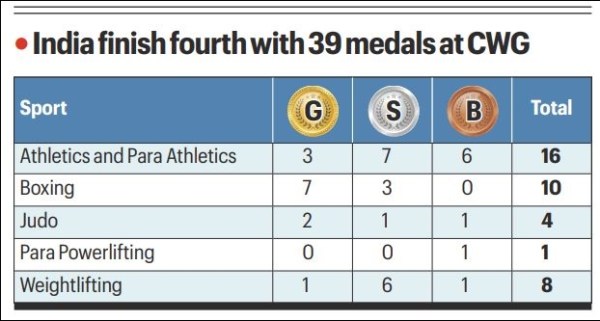 India’s medal splits at CWG 2026 in Glasgow.
That’s not all. Across sports, new names stepped forward and seized their opportunities.
Story continues below this ad
In the boxing ring, Sakshi Chaudhary, who got the nod ahead of former world champion Nikhat Zareen in the women’s 51kg category, announced herself by winning gold. Her fearlessness and swagger illustrated both the competition for places within Indian boxing and the depth in the division. On the track, Gulveer broke new ground, while Tejaswin finally earned a Commonwealth decathlon medal after years of near-misses and interrupted campaigns.
Their breakthroughs, along with judo’s emergence, meant Glasgow was less about established names extending their dominance and more about new stories taking shape. The feel-good factor, however, comes with an asterisk. The bigger test will be at the Asian Games, from September 19 to October 4.
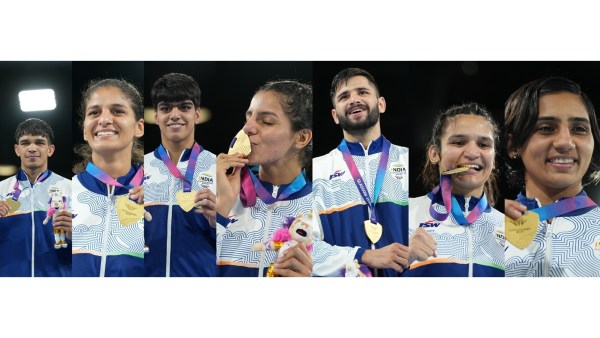 The seven gold medals and three silver won by the pugilists makes India the top boxing contingent at the 2026 Commonwealth Games. (AP Photo)
Take boxing, for instance. The seven gold medals deserve to be celebrated, particularly given the churn the sport has experienced over the last couple of Olympic cycles. Yet the competitive landscape changes dramatically once Kazakhstan, Uzbekistan, China, Japan and other Asian powers enter the fray. Glasgow demonstrated India’s strength within the Commonwealth; Aichi-Nagoya, which hosts the Asiad in Japan, will reveal where it stands in Asia, which in turn will offer a clearer indication of its standing globally.
Athletics presents an equally intriguing, though very different, picture. If Glasgow highlighted India’s progress, it also served as a reminder that some of its traditional strengths can no longer be taken for granted.
Story continues below this ad
Javelin, transformed over the last decade by Neeraj Chopra, is becoming increasingly competitive across the continent. Pakistan’s Arshad Nadeem had already altered the regional equation; now Sri Lanka’s Rumesh Pathirage has emerged as another genuine challenger. What has long been viewed as India’s signature athletics event could become one of its fiercest battlegrounds at the Asian Games. India’s depth in the event, though, was evident once again as the relatively unknown Yash Vir Singh threw a personal best 85.41m to ensure two Indians finished on the podium.
If one sport leaves India with more questions than answers, it is weightlifting. Historically one of India’s most reliable Commonwealth medal sources, weightlifting once again delivered podium finishes but also exposed concerns heading into the next phase of the cycle. The sport’s gold medal count has been steadily declining: from five at the 2018 Gold Coast Games, to three in Birmingham four years later, to just one in Glasgow. With Mirabai Chanu unlikely to continue until 2030, even that solitary gold could become harder to secure when the Games return to India.
None of this should diminish what India achieved in Glasgow. The Commonwealth Games have always occupied an unusual space in India’s sporting calendar — important enough to generate momentum, yet different enough from the Asian Games and the Olympics to warrant caution when drawing conclusions. Success here guarantees nothing, but it often provides the first indication that a new generation is ready.
That is perhaps Glasgow’s greatest takeaway for India: fresh champions, new milestones, and evidence that some programmes are moving in the right direction while others require urgent course correction. As appetisers go, this was satisfying. The main course now awaits at the Asian Games, where India’s encouraging story will be subjected to far sterner scrutiny.