


For the man who had conjured magic throughout this World Cup, carrying Argentina through one knockout battle after another, as he has done countless times in his glittering career, the biggest night of them all ended in silence. Lionel Messi was subdued. Argentina fell.
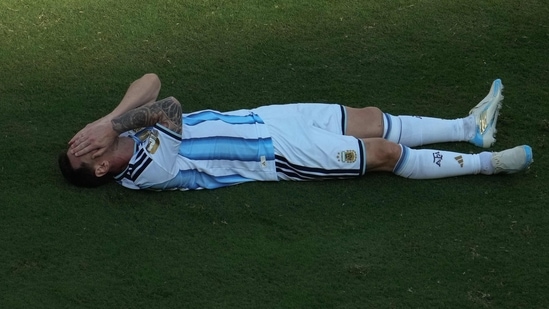
A decade ago, Messi walked out of MetLife Stadium in New York convinced his international career was over. The heartbreak of losing the 2016 Copa America final to Chile, two years after Argentina’s World Cup final defeat to Germany, left him shattered. “It’s over,” he had said.
Less than two months later, he reversed his retirement. What followed became the greatest chapter of his international career: two Copa America titles and, finally, the World Cup triumph in Qatar four years ago. Returning to the very same MetLife Stadium for what he had already indicated would be his final World Cup appearance, Messi hoped for the perfect farewell.
For once, though, football had a different ending in mind.
The man who had driven Argentina’s run to the final with eight goals and four assists walked away empty-handed. In one evening, Messi lost the World Cup, the Golden Ball and the Golden Boot.
ALSO READ: Spain end Argentina’s reign as Ferran Torres strikes in extra time to win World Cup after 16 years
His involvement was strangely minimal from the outset. Messi barely touched the ball until after the first hydration break. There was an early glimpse of danger when a perfectly weighted through ball sent him racing clear, forcing Unai Simon into a brave charge almost to the halfway line to snuff out the chance. Beyond that, however, Messi remained largely peripheral.
Few players in football history have produced more iconic World Cup performances. This tournament alone had seen him surpass Germany’s Miroslav Klose to become the competition’s all-time leading scorer, with his display against Switzerland in the quarterfinal standing among his finest.
Against Spain, however, Messi looked unusually subdued.
It feels almost sacrilegious to say it about arguably the greatest footballer of all time, but Messi simply did not influence this final. As Spain dominated possession and dictated the tempo, Argentina’s captain spent long stretches watching from afar while La Roja methodically dismantled the defending champions.
He failed to create a single chance across 120 minutes — only the second time that has happened in his last five major tournaments, spanning three World Cups and two Copa America campaigns. He finished with just 54 touches, none inside Spain’s penalty area. His only effort on goal came deep into extra time, and even that was blocked before it could trouble Simon.
It was a painfully fitting end to a night that unravelled in every possible way.
Until the semifinals, Messi had led the Golden Boot race. Bookmakers overwhelmingly backed him to become the first player in history to win a third Golden Ball. Argentina, meanwhile, appeared destined to become the first nation in 64 years to successfully defend the World Cup.
Instead, everything slipped away.
Ferran Torres’ 106th-minute winner condemned Argentina to defeat after arguably their poorest performance in a World Cup final. Messi’s dream ending disappeared with it.
He needed at least a hat-trick, or two goals and an assist, to reclaim the Golden Boot, but the award instead went to Kylian Mbappe, whose 10 goals and four assists made him the first player in history to win the prize twice. Messi settled for the Silver Boot. The Player of the Tournament award followed a similar script. Rodri, back to the form that won him the Ballon d’Or, claimed the Golden Ball, while Messi received the Silver Ball.
Individual honours have rarely defined World Cups. The trophy always matters more.
Mbappe himself admitted he would gladly swap his Golden Boot for the title. For Messi, too, the World Cup was all that mattered. It represented the chance to script the perfect farewell and lead Argentina to a feat unseen for more than six decades.
It was not to be.
Yet one heartbreaking night does little to diminish what Messi achieved in this tournament, across six World Cups, or throughout his extraordinary international career. He remains a World Cup winner, Argentina’s greatest footballer, the tournament’s all-time leading scorer, and still the only player to have won the Golden Ball twice, in 2014 and 2022.


