


“Where do you think you are going?” an inspector of the Jammu and Kashmir Police shouts, just as one is about to leave the railway station.
Put it down to naivety. In Baramulla, unlike anywhere else in the country, one can’t walk in and out of a railway station as one pleases. Every arrival must account for itself. A reason must be furnished, identification produced, an interrogation endured.
The next five minutes go in explaining that the visit has little to do with the turbulent past or present of the region. The writer had come, instead, to trace the roots of Auqib Nabi, the pacer who has been named in India’s ODI squad for the five-match series against New Zealand.
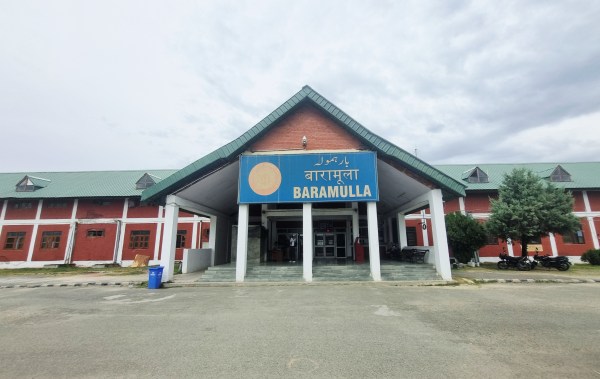 In Baramulla, unlike anywhere else in the country, one can’t walk in and out of a railway station as one pleases. (Express Photo)
Only after a thorough scrutiny is permission granted to leave the premises. A teacher who makes this journey often, and has just endured the same interrogation, offers a wry observation.
“Now you know you have arrived in the last district of India. Welcome to Baramulla.”
***
(2)
Seven kilometres from the station, beside the camp of 46 Rashtriya Rifles, stands the General Bipin Rawat Stadium — home of BCC Reds, Auqib’s first club.
Story continues below this ad
“This place was not always this happening,” quips Zubair Dar, his first captain.
“This ground was built in the 1980s. But in 1988, insurgency took over Kashmir. Cricket was completely out of the question. The ground was sealed, and reopened only in 2016.”
Beside him sits Muzaffar Mattoo, Nabi’s first coach, whose memories run along similar lines.
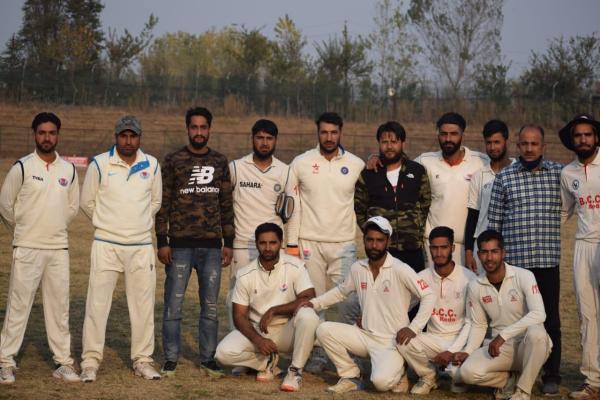 Auqib with his BCC Reds team. (Special Arrangement)
“In my time, cross-firing would frequently erupt nearby. I remember days when while we were practicing, a grenade would be lobbed, panic would spread, and people would scramble for cover. We were caught in such situations several times.”
Story continues below this ad
From such soil has an India player grown. How? The story begins in 2012.
***
(3)
“My team, BCC Reds, had travelled to Gantamulla to play a game against Auqib’s village. We won, as we were expected to, but I was blown away by the sheer talent of a Class 8 kid. He took four wickets and scored 55 runs. I knew immediately that such a talent should not go to waste,” Dar recalls.
An offer followed: Come and play for Baramulla’s only JKCA-affiliated club.
For any village cricketer, it would have been a dream realised. What Dar did not know was that Auqib was not supposed to be on the field at all. He was meant to be at home, buried in his books.
Story continues below this ad
“Auqib’s father did not even know he was at the ground that day. Turns out, he had sneaked out. He has done it often. His father was a teacher and wanted his son to become a doctor. It took a lot of convincing for him to let Auqib join our team.”
***
(4)
Nabi was soon the star of Baramulla. Trouble came when his horizons widened.
“We were to go to Srinagar for a 50-over game, which also was Auqib’s first match on a turf wicket. For any Kashmiri, playing at the Sher-i-Kashmir Stadium is a dream. He was naturally excited, so much so that he did not even sleep the night before. But there was a problem.”
Mattoo takes up the tale.
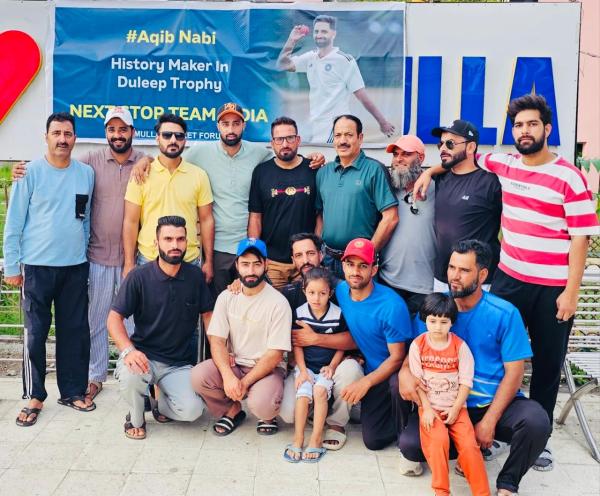 Baramulla-celebrating Auqib’s Duleep Trophy performance. (Special Arrangement)
“I bowled the first over, and he was supposed to bowl the second. As he approached the 22 yards, he fell flat on the pitch on the very first delivery. We were all shocked and ran towards him. Turns out, he did not have spikes in his shoes; he did not even know the use of them. I gave him my shoes. As we bowled in tandem, we exchanged shoes after every over. To think that the same guy now plays for India…”
Story continues below this ad
With no expert guidance until 14, the ship of Under-16 cricket had sailed. At the Under-19 level, however, Nabi broke into the Jammu & Kashmir side, and never looked back.
“He was an instant star. Auqib scored 60-odd in his second game against Punjab, which got us the first-ever U-19 win over them. In his next game, he scored 105 against Saurashtra in Rajkot. He took wickets aplenty. That season opened up a great opportunity for him.”
***
(5)
That opportunity was a specialised pace-bowling camp run by the BCCI under Glenn McGrath, with Mohammed Shami and Varun Aaron also involved. A letter bearing Auqib’s name arrived at the JKCA office, and when the news reached Baramulla, celebrations erupted.
Until, Auqib delivered the line R Madhavan’s character speaks in ‘3 Idiots’: “Abba nahin manenge.”
Story continues below this ad
“He was hell-bent on not letting him go. He was of the opinion that traveling with the team was not the same as travelling alone all the way to Chennai. This time around, we had to be really persistent in our attempt to convince him. Eventually, he agreed, and I believe that was the turning point of Auqib’s career. The coaching he received under McGrath helped perfect his bowling fundamentals. They analysed his videos and gave him CDs showing exactly what he needed to work on.
“When he returned, he brought back an entire professional regime. He understood nutrition, fitness, lifestyle, training and fast-bowling mechanics. He learnt what elite fast bowling actually required. Before that, he was raw. It was McGrath who polished him.”
***
(6)
Nabi is only one game old in international cricket, but across these parts his influence is already felt, and seen. In the hope of unearthing more Auqibs, the Baramulla district administration has built an all-weather nets facility costing Rs 65 lakh, so that children can practise through the winter.
“This is the same place where parents would be afraid to send their kids, and cricket came to a standstill for nearly 30 years. Such progress would not have happened had Auqib not made it big,” says Dar.


