


India’s T20I era under Shreyas Iyer is gathering momentum. After losing 2-0 in Ireland and 4-0 in England, they have won 10 of their last 11 T20Is, with Sunday’s 14-run win over West Indies in Indore the latest. This run has come without Jasprit Bumrah, whose workload is managed with the ODI World Cup in mind. In his absence, Mayank Yadav has been the most exciting quick to step up.
In six spells against Zimbabwe and West Indies, Mayank has taken nine wickets for 182 runs in 22 overs at an economy rate of 8.27.
He gives India something different: an out-and-out quick who can touch 150 kmph. India have had fast bowlers, but rarely a regular, fit option with the raw pace of Jofra Archer, Mark Wood or Anrich Nortje. At that speed, batsmen have less time to settle or commit to a stroke. If Mayank stays fit and works on his control, his pace could give India a weapon they have lacked.
In Indore, Mayank went wicketless for 34, but his first two overs were threatening. He found movement away from right-handers, beat the edges and drew one from Shimron Hetmyer’s bat that was dropped. Later, Hetmyer pulled a slower short ball for four, and Sherfane Rutherford hit a missed yorker for six. Mayank’s pace troubled the batsmen.
ALSO READ | Nitin Menon’s father, 80, still umpires junior cricket in Indore
He showed his real attributes in the second game at Ranchi. His 3/36 included wickets of Kamil Pooran and Hetmyer, both against short balls, before he bowled Rovman Powell with a 149.5 kmph delivery that hit off stump. Rutherford then struck two fours and a six.
In Lucknow, Shai Hope attacked his fast and slower balls, while Rutherford picked changes of pace when they landed short or within his reach, hitting boundaries off deliveries at 112-119 kmph. His slower balls proved ineffective when the length gave the batsman time to adjust.
Story continues below this ad
On his return against Zimbabwe after nearly two years away, Mayank took 2/18, dismissing Bennett with his first ball, which moved away, and Myers after beating him at around 145 kmph. He went wicketless in the second match, then took 3/29 in the third.
At 150 kmph, Mayank gives batsmen little time to settle. If the ball moves late or climbs from a good length, even a defensive shot can produce an edge. But batsmen can use that pace against him if they anticipate the line and length.
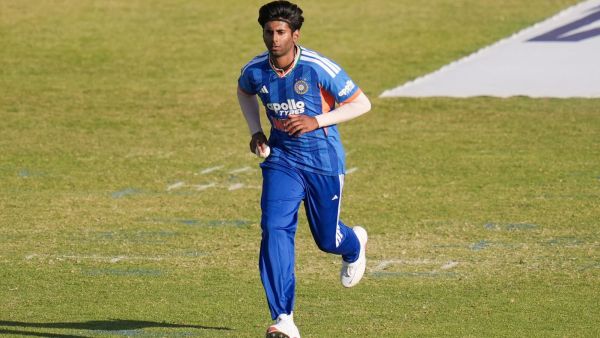 Mayank Yadav in action. (Faheem Hussain / CREIMAS for BCCI)
The comeback was also a struggle off the field. Mayank’s coach, Devendra Sharma, said recurring injuries eventually led to a diagnosis of a back injury, leaving him to decide whether to have surgery. “The comeback was a huge struggle. It was very tough because injuries kept recurring, and later it was discovered that he had a back injury,” he told The Indian Express.
Rehabilitation took four to five months. Sharma said Mayank had self-doubts every day. “Every single day there was that question – ‘Will I be able to play again?’ – because strengthening takes a lot of time.” He had to rebuild gradually.
Story continues below this ad
Sharma said Mayank kept visiting his club in Delhi to discuss his progress, but the specialised machines he needed were at the NCA in Bengaluru. By the time his IPL team assessed him for retention, he was bowling 10 to 15 overs a day at the NCA. “Once he got back to about 125 kmph, the confidence slowly returned,” Sharma said.
Sharma believed Mayank’s pace was natural, but the challenge was trusting his body again. “His pace is purely natural and god-gifted. It is always bound to come back to him; the challenge was just to avoid the psychological block.” Before Mayank returned to India duty, Sharma advised him to put IPL setbacks behind him, read batsmen’s footwork and scoring areas, avoid predictable short balls and use variations. He must sharpen his yorker and cut down on extras.
Like Kagiso Rabada, Mayank needs to develop well-disguised slower balls and deadlier yorkers so that his pace does not become the only part of his repertoire.
Story continues below this ad
At the other end of the spectrum is Prince Yadav. Brought into the XI for Kuldeep Yadav in Indore, he went wicketless, conceding 37 in four overs. Hetmyer pulled a short ball for four, while Springer launched a missed yorker for six. Prince deceived Roston Chase with a slower short ball, but his yorkers and control at the death remain a work in progress.
His Zimbabwe spells were better. He dismissed Ben Curran in both matches, inducing a mistimed pull and then a leading edge. Fuller balls swinging into left-hander Ryan Burl kept beating his inside edge. Prince took four wickets for 29 runs in 5.2 overs. Where Mayank relies on raw pace, Prince uses movement and accurate lengths.
With the 2028 T20 World Cup in Australia and New Zealand ahead, India have time to build options beyond Bumrah. Mayank brings pace; Prince offers movement and control. Both must stay fit, limit extras and deliver under pressure. India don’t need to find another Bumrah, but quicks they can trust for four overs.
(With inputs from Shuvaditya Bose)


